

| Distributor | Stock | Pricing | MOQ | PKG | Lead Time | Date Code | On Order Quantity | On Order Delivery | |
|---|---|---|---|---|---|---|---|---|---|
|
2,500 pcs
|
2500 pcs | On Request | 1 | On Request | On Request | On Request | On Request | On Request | |
|
65 pcs
|
65 pcs | On Request | 1 | On Request | On Request | 0418G/A/ | On Request | On Request | |
|
47 pcs
|
47 pcs | On Request | 1 | On Request | On Request | On Request | On Request | On Request |
| Category | |
| Manufacturer Name | |
| Clock Frequency | |
| Data Rate | |
| Function | |
| Input Type | |
| Lead Spacing | |
| Mounting Type | |
| Number of Inputs | |
| Number of Outputs | |
| Operating Temperature | |
| Output Type | |
| Power Consumption | |
| Storage Temperature | |
| Supplier Device Package | |
| Tape & Reel | |
| Voltage |
The DS92LV1023TMSA from Texas Instruments is a 400 to 660 Mb/s serializer that supports high-speed unidirectional serial data transmission over FR-4 printed circuit board backplanes and balanced copper cables. It converts a 10-bit wide parallel LVCMOS/LVTTL data bus into a single high-speed Bus LVDS serial data stream, simplifying PCB design and reducing costs.
This device operates with a clock frequency range of 40 MHz to 66 MHz and features a data rate of up to 660Mbps. It requires a supply voltage between 3V and 3.6V and operates within an ambient temperature range of -40°C to 85°C. The output type is LVDS, and the input is compatible with LVCMOS and LVTTL logic levels.
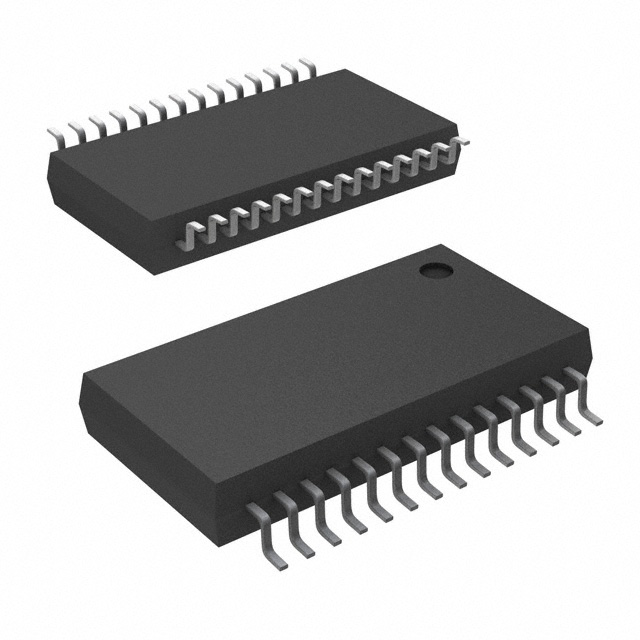
The DS92LV1023TMSA is available in a compact 28-SSOP (0.209", 5.30mm Width) package, designed for surface mounting. Its flow-through pinout facilitates easy PCB layout. The serializer consumes low power, typically less than 250 mW at 66 MHz.
The DS92LV1023TMSA has a data rate of 660Mbps.
The DS92LV1023TMSA provides an LVDS output.
The operating voltage range is 3V to 3.6V.
The operating temperature range is -40°C to 85°C (TA).
The DS92LV1023TMSA is supplied in a 28-SSOP package.
The DS92LV1023TMSA is designed for surface mounting.
The typical power consumption is less than 250 mW at 66 MHz.