

| Distributor | Stock | Pricing | MOQ | PKG | Lead Time | Date Code | On Order Quantity | On Order Delivery | |
|---|---|---|---|---|---|---|---|---|---|
|
3 pcs
|
3 pcs | On Request | 1 | On Request | On Request | On Request | On Request | On Request |
| Category | |
| Manufacturer Name | |
| Clock Frequency | |
| Current | |
| ESD Protection | |
| Function | |
| Input Capacitance | |
| Max Propagation Delay @ V, Max CL | |
| Mounting Type | |
| Number of Bits per Element | |
| Number of Elements | |
| Operating Temperature | |
| Output Type | |
| SVHC Present | |
| Supplier Device Package | |
| Supplier Package | |
| Trigger Type | |
| Type | |
| Voltage |
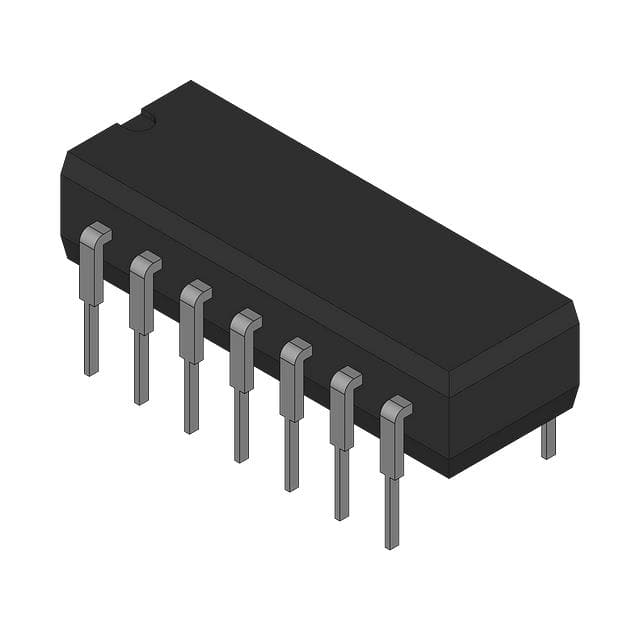
The CD74AC74E is a dual D-type flip-flop integrated circuit from Harris Semiconductor, part of the AC logic family. Each flip-flop has independent set and reset inputs, and operates on a positive edge trigger. The device contains two elements, each with 1 bit, and provides complementary outputs. It operates over a supply voltage range of 1.5V to 5.5V, with a maximum clock frequency of 110 MHz. The propagation delay is 10 ns at 5V with 50 pF load. The quiescent current draw is only 4 µA, making it suitable for low-power applications. The device features ESD protection exceeding 2 kV per MIL-STD-883, Method 3015, and offers ±24 mA output drive capability with fanout to 15 F devices. It is housed in a 14-pin PDIP (0.300 inch, 7.62 mm) through-hole package, suitable for breadboard and prototyping. The operating temperature range is -55°C to 125°C, allowing use in extreme environments. This flip-flop is ideal for general-purpose register, storage, and timing applications in digital logic designs.
| Qty | Low | High |
|---|---|---|
| 1+ | $1.23 | $1.23 |
Estimated market price range - modelled values for guidance only, not live distributor offers.
The CD74AC74E operates from 1.5V to 5.5V.
The CD74AC74E is available in a 14-pin PDIP (0.300 inch, 7.62 mm) through-hole package.
The CD74AC74E operates from -55°C to 125°C.
110 MHz.
10 ns at 5V, 50 pF load.
Positive edge.
Yes, it exceeds 2 kV ESD protection per MIL-STD-883, Method 3015.