

| Distributor | Stock | Pricing | MOQ | PKG | Lead Time | Date Code | On Order Quantity | On Order Delivery | |
|---|---|---|---|---|---|---|---|---|---|
|
8,036 pcs
|
8036 pcs | On Request | 1 | On Request | On Request | On Request | On Request | On Request |
| Category | |
| Manufacturer Name | |
| Connectivity | |
| Core Processor | |
| Core Size | |
| Data Converters | |
| EEPROM Size | |
| Mounting Type | |
| Number of I | |
| Operating Temperature | |
| Oscillator Type | |
| Peripherals | |
| Program Memory Size | |
| Program Memory Type | |
| RAM Size | |
| Speed | |
| Supplier Device Package | |
| Voltage |
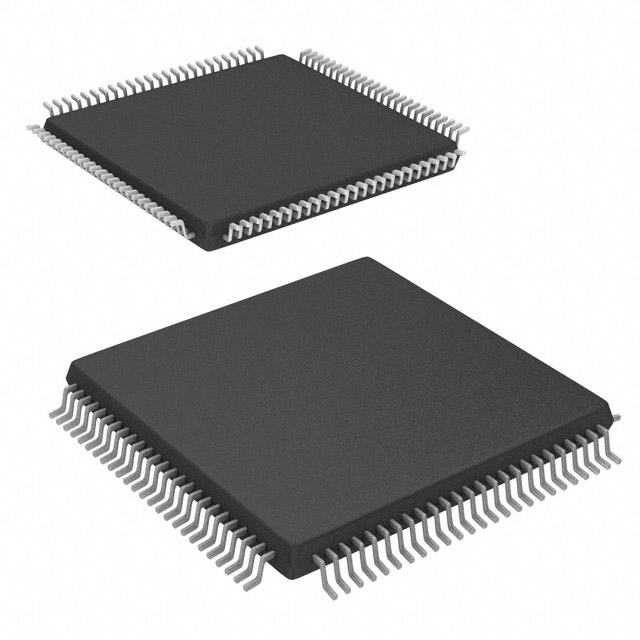
The ATXMEGA128A1-AUR is an 8/16-bit AVR XMEGA microcontroller from Microchip Technology, designed for high-performance and low-power embedded applications. It features a 32MHz AVR core with 128KB of in-system self-programmable Flash memory, 8KB SRAM, and 2KB EEPROM. The device includes a rich set of peripherals: four-channel DMA controller, eight-channel event system, eight 16-bit timer/counters, eight USARTs, four I2C/SMBus interfaces, four SPIs, and an external bus interface (EBI/EMI) supporting up to 16MB SRAM or 128Mbit SDRAM. It also integrates two 16-channel 12-bit ADCs and two 2-channel 12-bit DACs.
The microcontroller operates from 1.6V to 3.6V and over a temperature range of -40°C to 85°C. It is available in a 100-lead TQFP package (14x14mm) for surface mount assembly. The datasheet indicates this part is not recommended for new designs; Microchip recommends the XMEGA A1U series as a replacement. The device supports JTAG and PDI programming/debug interfaces and includes brown-out detection, power-on reset, and multiple sleep modes for power management.
The operating voltage range is 1.6V to 3.6V.
It comes in a 100-TQFP (14x14mm) surface mount package.
The operating temperature range is -40°C to 85°C.
The RoHS status is listed as RoHS3 Compliant, but this is unverified and should be confirmed from official sources.
It has an 8/16-bit AVR XMEGA core running at 32MHz.
It has 128KB Flash and 8KB SRAM.
Peripherals include DMA, event system, eight 16-bit timers, eight USARTs, four I2C, four SPI, two 12-bit ADCs (16 channels each), and two 12-bit DACs.