

| Distributor | Stock | Pricing | MOQ | PKG | Lead Time | Date Code | On Order Quantity | On Order Delivery | |
|---|---|---|---|---|---|---|---|---|---|
|
5,750 pcs
|
5750 pcs | On Request | 1 | On Request | On Request | On Request | On Request | On Request |
| Category | |
| Manufacturer Name | |
| Connectivity | |
| Core Processor | |
| Core Size | |
| EEPROM Size | |
| Mounting Type | |
| Number of I | |
| Operating Temperature | |
| Oscillator Type | |
| Peripherals | |
| Program Memory Size | |
| Program Memory Type | |
| RAM Size | |
| Speed | |
| Supplier Device Package | |
| Voltage | |
| Watchdog Timer |
The ATTINY2313-20PU is a low-power, high-performance 8-bit microcontroller based on the AVR enhanced RISC architecture. It features 2KB of in-system self-programmable Flash memory with 10,000 write/erase cycles, 128 bytes of SRAM, and 128 bytes of EEPROM with 100,000 write/erase cycles. The device operates at a maximum clock frequency of 20 MHz, delivering up to 20 MIPS throughput.
Peripheral features include one 8-bit and one 16-bit timer/counter, four PWM channels, an on-chip analog comparator, a programmable watchdog timer with on-chip oscillator, and a USI for serial communication. Connectivity options include SPI and UART/USART interfaces. The microcontroller also supports debugWIRE on-chip debugging and in-system programming via the SPI port.
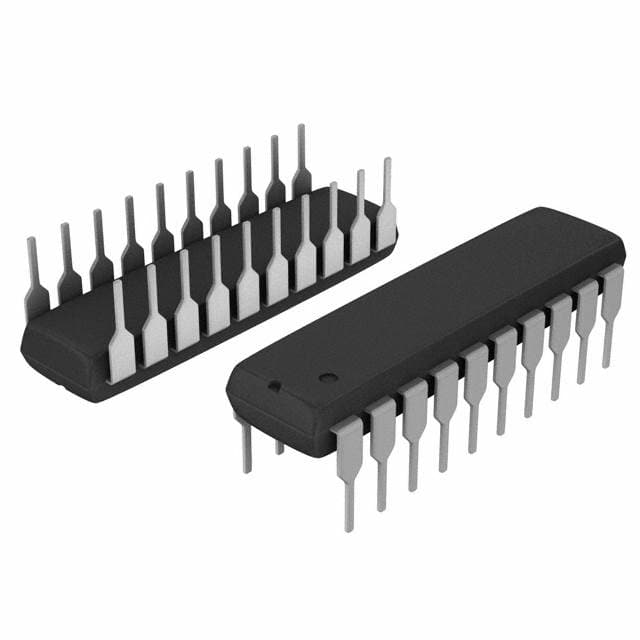
The ATTINY2313-20PU is housed in a 20-pin PDIP package and supports through-hole mounting. It operates over a supply voltage range of 2.7V to 5.5V and a temperature range of -40°C to 85°C. Typical power consumption is 230 µA at 1 MHz and 1.8V in active mode, and less than 0.1 µA in power-down mode.
The operating voltage range is 2.7V to 5.5V.
It comes in a 20-pin PDIP (20-DIP) package for through-hole mounting.
The operating temperature range is -40°C to 85°C.
The RoHS status is listed as RoHS3 compliant, but this is unverified and should be confirmed with the manufacturer.
The maximum clock frequency is 20 MHz.
It has 2KB of Flash program memory.
It supports SPI and UART/USART interfaces.