

| Distributor | Stock | Pricing | MOQ | PKG | Lead Time | Date Code | On Order Quantity | On Order Delivery | |
|---|---|---|---|---|---|---|---|---|---|
|
790 pcs
|
790 pcs | On Request | 1 | On Request | On Request | On Request | On Request | On Request |
| Category | |
| Manufacturer Name | |
| Connectivity | |
| Core Processor | |
| Core Size | |
| Data Converters | |
| EEPROM Size | |
| Lead Spacing | |
| Lead Style | |
| Mounting Type | |
| Number of I | |
| Operating Temperature | |
| Oscillator Type | |
| Peripherals | |
| Program Memory Size | |
| Program Memory Type | |
| RAM Size | |
| Speed | |
| Supplier Device Package | |
| Termination Style | |
| Voltage | |
| Watchdog Timer |
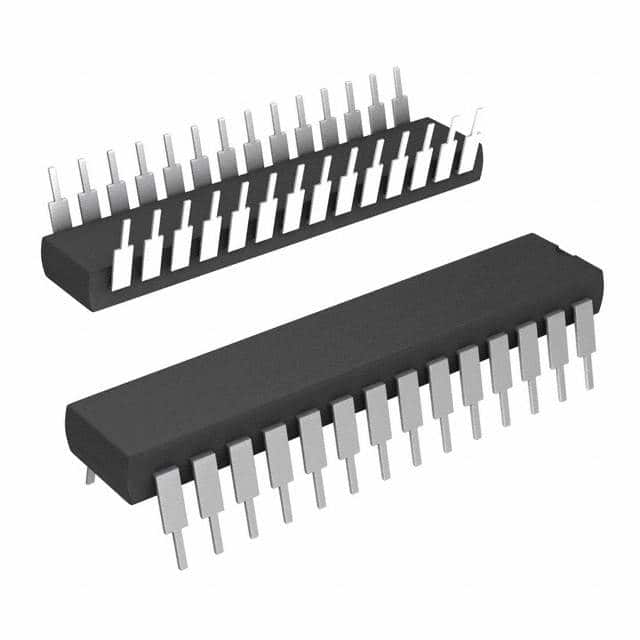
The ATMEGA328P-PN is a low-power, high-performance 8-bit AVR microcontroller based on the advanced RISC architecture. It features 32KB of in-system self-programmable Flash, 2KB SRAM, and 1KB EEPROM with high endurance: 10,000 write/erase cycles for Flash and 100,000 for EEPROM. Data retention is rated at 20 years at 85°C and 100 years at 25°C.
The device operates over a supply voltage range of 1.8V to 5.5V and supports clock frequencies up to 20 MHz at 4.5V-5.5V. It includes 23 general-purpose I/O lines, a 6-channel 10-bit ADC, and multiple serial communication interfaces: I²C, SPI, and UART/USART. Peripherals include two 8-bit timers, one 16-bit timer, PWM channels, a programmable watchdog timer, and brown-out detection. The internal oscillator reduces external component count.
This microcontroller is available in a 28-pin DIP (0.300 inch width) through-hole package, making it suitable for prototyping and production. Its power consumption is optimized: 0.2 mA active at 1 MHz and 1.8V, 0.1 µA in power-down mode, and 0.75 µA in power-save mode with RTC running. The operating temperature range is -40°C to 85°C.
1.8V to 5.5V.
28-pin DIP (0.300 inch width, 7.62mm) through-hole package.
-40°C to 85°C.
Yes, it is RoHS3 compliant (unverified).
20 MHz at 4.5V-5.5V, 10 MHz at 2.7V-5.5V, 4 MHz at 1.8V-5.5V.
32KB Flash, 2KB SRAM, 1KB EEPROM.
I²C, SPI, UART/USART.