

| Distributor | Stock | Pricing | MOQ | PKG | Lead Time | Date Code | On Order Quantity | On Order Delivery | |
|---|---|---|---|---|---|---|---|---|---|
|
1,500 pcs
|
1500 pcs | On Request | 1 | On Request | On Request | 21+ | On Request | On Request |
| Category | |
| Manufacturer Name | |
| Connectivity | |
| Core Processor | |
| Core Size | |
| Data Converters | |
| EEPROM Size | |
| Mounting Type | |
| Number of I | |
| Operating Temperature | |
| Oscillator Type | |
| Peripherals | |
| Program Memory Size | |
| Program Memory Type | |
| RAM Size | |
| SVHC Present | |
| Speed | |
| Supplier Device Package | |
| Voltage |
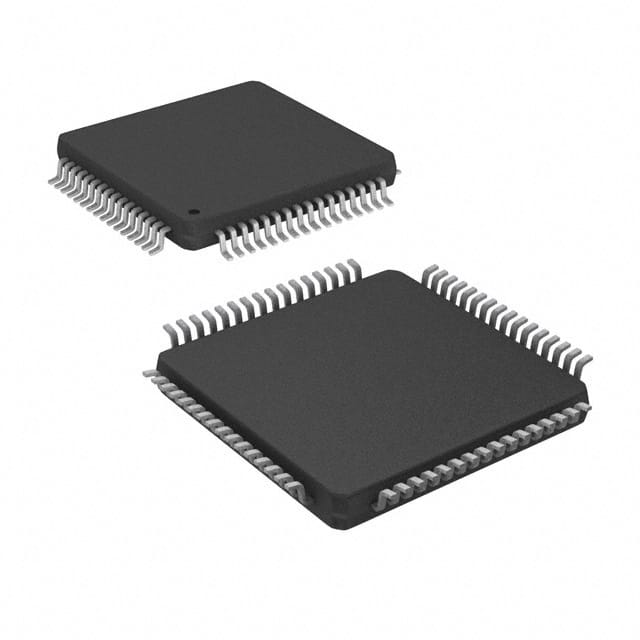
The AT90CAN64-16AU is an 8-bit AVR microcontroller from Microchip Technology, designed for embedded applications requiring robust communication and control. It features a high-performance RISC architecture with 133 instructions, most executed in a single clock cycle, achieving up to 16 MIPS throughput at 16 MHz.
Memory resources include 64KB of in-system reprogrammable Flash with 10,000 write/erase cycles, 4KB internal SRAM, and 2KB EEPROM with 100,000 write/erase cycles. The device integrates a CAN controller (2.0A and 2.0B, ISO 16845 certified) with 15 message objects, along with I2C, SPI, and UART/USART serial interfaces. Peripherals include an 8-channel 10-bit ADC, multiple timers with PWM, brown-out detection, and a watchdog timer.
The microcontroller operates from 2.7V to 5.5V and over a temperature range of -40°C to 85°C. It is housed in a 64-TQFP package (14x14 mm) with surface mount mounting. With 53 general-purpose I/O lines and support for external memory up to 64KB, it is suitable for automotive, industrial, and complex embedded systems.
The operating voltage range is 2.7V to 5.5V.
It comes in a 64-TQFP package (14x14 mm).
The operating temperature range is -40°C to 85°C.
RoHS status is listed as RoHS3 Compliant, but this data is unverified and low confidence.
It has an 8-bit AVR core with a maximum clock speed of 16 MHz.
It has 64KB Flash program memory and 4KB SRAM.
It supports CANbus, EBI/EMI, I2C, SPI, and UART/USART.