
BC847B/215
Nexperia USA Inc.
The Nexperia USA Inc. BC847B/215 is a bipolar transistor. It is RoHS3 Compliant and has an MSL Level 1 rating.


| Distributor | Stock | Pricing | MOQ | PKG | Lead Time | Date Code | On Order Quantity | On Order Delivery | |
|---|---|---|---|---|---|---|---|---|---|
|
9,831 pcs
|
9831 pcs | On Request | 1 | On Request | On Request | 21+ | On Request | On Request | |
|
1,000 pcs
|
1000 pcs | On Request | 1 | On Request | On Request | On Request | On Request | On Request | |
|
80 pcs
|
80 pcs | On Request | 1 | On Request | On Request | 21+ | On Request | On Request |
| Category | |
| Manufacturer Name | |
| Tape & Reel |
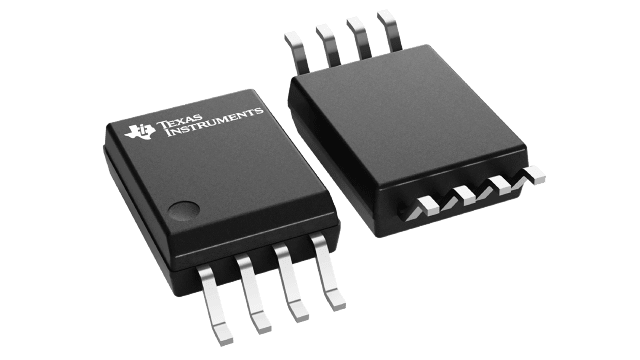
The AMC1300BDWVR from Texas Instruments is a precision, reinforced isolated amplifier designed for current sensing applications. It features a ±250-mV input voltage range, optimized for use with shunt resistors.
The device provides robust isolation with a withstand voltage of 5000 Vrms and a transient isolation voltage of 7000 VPK. It boasts high common-mode transient immunity (CMTI) of up to 75 kV/µs and operates over a wide temperature range of -55°C to 125°C.
Key electrical characteristics include a fixed gain of 8.2 and low DC errors. For the AMC1300B variant, offset error is a maximum of ±0.2 mV with a drift of ±0.9 µV/°C, and gain error is ±0.3% with a drift of ±30 ppm/°C. The AMC1300 offers slightly higher maximums for offset error (±2 mV) and offset drift (±4 µV/°C), with gain error at ±1% and gain drift at ±50 ppm/°C typical. Nonlinearity is a maximum of 0.03%.
Packaged in an SOIC (DWV) format, the AMC1300BDWVR is suitable for surface mounting. It meets CISPR-11 and CISPR-25 standards for low EMI and includes system-level diagnostic features.
| Qty | Low | High |
|---|---|---|
| 1+ | $2.07 | $2.07 |
Estimated market price range - modelled values for guidance only, not live distributor offers.
The peak-to-peak input voltage range is 0.25 V.
It has a withstand isolation voltage of 5000 Vrms and a transient isolation voltage of 7000 VPK.
The operating temperature range is -55°C to 125°C.
The fixed gain is 8.2.
For the AMC1300B, the offset error is ±0.2 mV maximum, offset drift is ±0.9 µV/°C maximum, gain error is ±0.3% maximum, and gain drift is ±30 ppm/°C maximum.
The nonlinearity is 0.03% maximum.
Yes, it meets CISPR-11 and CISPR-25 standards for low EMI.