

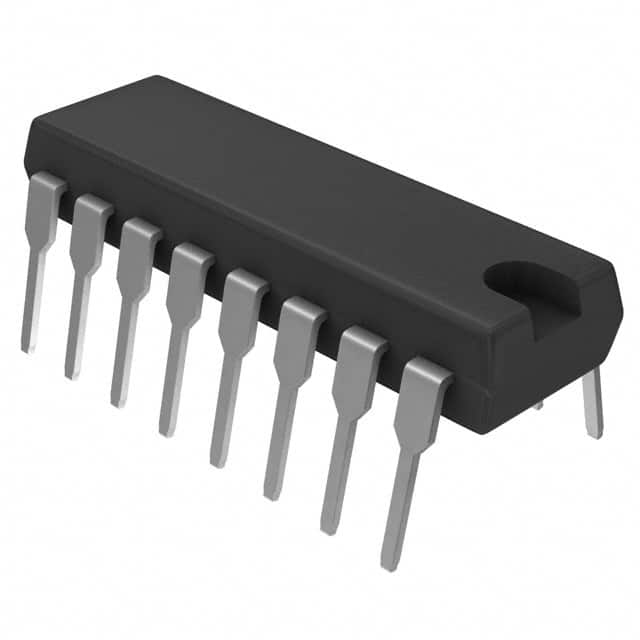
| Distributor | Stock | Pricing | MOQ | PKG | Lead Time | Date Code | On Order Quantity | On Order Delivery | |
|---|---|---|---|---|---|---|---|---|---|
|
203 pcs
|
203 pcs | On Request | 1 | On Request | On Request | On Request | On Request | On Request | |
|
76 pcs
|
76 pcs | On Request | 1 | On Request | On Request | On Request | On Request | On Request | |
|
5 pcs
|
5 pcs | On Request | 1 | On Request | On Request | On Request | On Request | On Request |
| Category | |
| Manufacturer Name | |
| Mounting Type | |
| Number of Drivers | |
| Operating Temperature | |
| SVHC Present | |
| Supplier Device Package | |
| Type | |
| Voltage |
The AM26C31CN from Texas Instruments is a quadruple differential line driver featuring complementary outputs, designed to meet TIA/EIA-422-B and ITU (formerly CCITT) requirements. This device operates from a single 5V supply and offers low power consumption with a typical ICC of 100μA. Its high-speed capability is demonstrated by typical propagation delays (tPLH, tPHL) of 7ns and low pulse distortion (tsk(p)) of 0.5ns.
The driver has 3-state outputs with high-current capability suitable for driving balanced lines like twisted-pair or parallel-wire transmission lines. It also provides a high-impedance state when power is off. The enable functions are common to all four drivers, with options for active-high or active-low enable inputs. The BiCMOS circuitry contributes to reduced power consumption without compromising speed.
This specific part, the AM26C31CN, is characterized for operation within a temperature range of 0°C to 70°C. It is housed in a 16-PDIP package and is suitable for through-hole mounting. The device meets or exceeds the requirements of TIA/EIA-422-B and ITU recommendation V.11.
| Qty | Low | High |
|---|---|---|
| 1+ | $0.89 | $0.89 |
Estimated market price range - modelled values for guidance only, not live distributor offers.
4.5V to 5.5V.
16-pin DIP (0.300", 7.62mm) through-hole.
The device is specified for -40°C to 125°C (industrial) and 0°C to 70°C (commercial).
4 drivers and 0 receivers.
7ns typical.
100μA typical.
0.5ns typical.