

| Distributor | Stock | Pricing | MOQ | PKG | Lead Time | Date Code | On Order Quantity | On Order Delivery | |
|---|---|---|---|---|---|---|---|---|---|
|
6,000 pcs
|
6000 pcs | On Request | 1 | On Request | On Request | On Request | On Request | On Request |
| Category | |
| Manufacturer Name | |
| Architecture | |
| Configuration | |
| Contact Plating | |
| Data Interface | |
| Input Type | |
| Mounting Type | |
| Number of A | |
| Number of Bits | |
| Number of Inputs | |
| Operating Temperature | |
| Power Dissipation | |
| Ratio | |
| Reference Type | |
| Sampling Rate (Per Second) | |
| Supplier Device Package | |
| Supply Current | |
| Supply Voltage | |
| Voltage |
The ADS574KP is a 12-bit successive approximation register (SAR) analog-to-digital converter (ADC) with a maximum sampling rate of 40 kS/s. It features a single-ended input configuration and a parallel data interface for straightforward connection to microcontrollers or digital systems. The device supports both external and internal voltage references, providing flexibility in system design.
Operating from a supply voltage range of 4.5V to 5.5V (typical 5V), the ADS574KP consumes 65 mW of power typically, with a maximum of 100 mW. It offers typical integral nonlinearity (INL) of 0.5 LSB and differential nonlinearity (DNL) of 1 LSB. The signal-to-noise ratio (SNR) is 72 dB, and the spurious-free dynamic range (SFDR) is 78 dB. The converter can handle both bipolar and unipolar input signals.
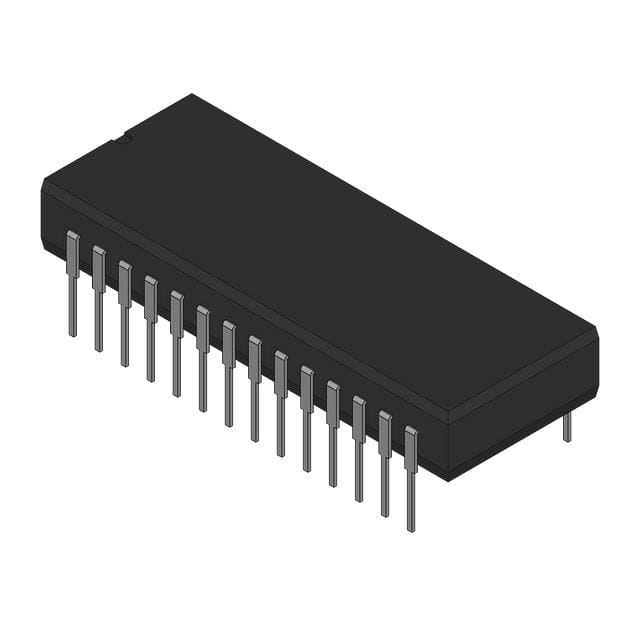
The ADS574KP is housed in a 28-pin DIP package (0.600" body width, 15.24mm pitch) with through-hole mounting, making it suitable for prototyping and industrial applications. The operating temperature range is 0°C to 70°C. The device is lead-free and listed as RoHS3 compliant.
The supply voltage range is 4.5V to 5.5V, with a typical value of 5V.
It comes in a 28-DIP (0.600", 15.24mm) package, also referred to as 28-PDIP.
The operating temperature range is 0°C to 70°C.
Yes, it is listed as RoHS3 compliant.
The resolution is 12 bits.
The sampling rate is 40 kS/s.
It uses a parallel data interface.