

| Distributor | Stock | Pricing | MOQ | PKG | Lead Time | Date Code | On Order Quantity | On Order Delivery | |
|---|---|---|---|---|---|---|---|---|---|
|
2,021 pcs
|
2021 pcs | On Request | 1 | On Request | On Request | 24+ | On Request | On Request |
| Category | |
| Manufacturer Name | |
| Data Rate | |
| Differential | |
| Frequency | |
| Input | |
| Main Purpose | |
| Mounting Type | |
| Number of Circuits | |
| Operating Temperature | |
| Output | |
| PLL | |
| Ratio | |
| Supplier Device Package | |
| Tape & Reel | |
| Voltage |
The ADN2855ACPZ-R7 is a burst mode clock and data recovery (CDR) IC from Analog Devices, specifically designed for use in GPON, BPON, and GEPON optical line terminal (OLT) receivers. It employs a patented dual-loop clock recovery architecture and integrates a deserializer for converting serial input data to a 4-bit parallel LVDS output.
Key electrical specifications include selectable data rates of 155.52 Mbps, 622.08 Mbps, 1244.16 Mbps, and 1250 Mbps, configurable via an I2C interface. The device operates from a single 3.3V supply (3.0V to 3.6V range) and features a typical power dissipation of 670 mW in serial output mode and 825 mW in deserializer mode. It achieves fast lock with a 12-bit acquisition time from the preamble start.
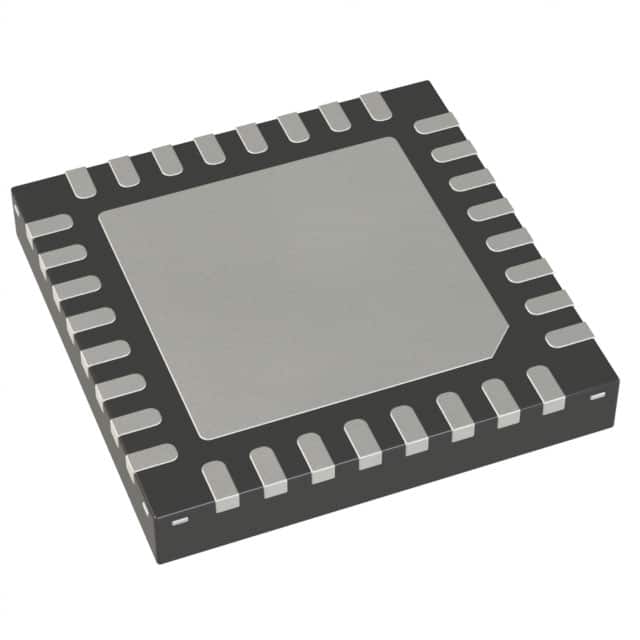
The ADN2855ACPZ-R7 is available in a 32-lead LFCSP package (5 mm × 5 mm) with an exposed pad, designed for surface mount assembly. It operates over the industrial temperature range of -40°C to +85°C. The device also includes a loss-of-lock indicator and supports double data rate (DDR) FPGA interfaces.
The supply voltage range is 3.0 V to 3.6 V, with a typical operation at 3.3 V.
The operating temperature range is -40°C to +85°C.
It is available in a 32-lead LFCSP (5 mm × 5 mm) with exposed pad, also described as 32-VFQFN Exposed Pad, CSP.
The part is listed as RoHS3 Compliant in the database, but this status is unverified and should be confirmed with the manufacturer.
It supports 155.52 Mbps, 622.08 Mbps, 1244.16 Mbps, and 1250 Mbps, selectable via I2C.
Typical power dissipation is 670 mW in serial output mode and 825 mW in deserializer mode.
It achieves lock within 12 bits after the start of the preamble.