

| Distributor | Stock | Pricing | MOQ | PKG | Lead Time | Date Code | On Order Quantity | On Order Delivery | |
|---|---|---|---|---|---|---|---|---|---|
|
2,500 pcs
|
2500 pcs | On Request | 1 | On Request | On Request | On Request | On Request | On Request |
| Category | |
| Manufacturer Name | |
| Data Rate | |
| Differential | |
| Frequency | |
| Input | |
| Main Purpose | |
| Mounting Type | |
| Number of Circuits | |
| Operating Temperature | |
| Output | |
| PLL | |
| Power Dissipation | |
| Ratio | |
| Supplier Device Package | |
| Voltage |
The ADN2814ACPZ from Analog Devices is a high-performance clock and data recovery (CDR) IC designed for SONET/SDH applications. It integrates a limiting amplifier and quantizer, providing receiver functions for data rates from 10 Mb/s to 675 Mb/s without requiring an external reference clock. The device automatically locks to all data rates within its range and meets SONET jitter requirements for transfer, generation, and tolerance.
Key electrical specifications include a typical supply voltage of 3.3V, power dissipation of 435 mW, and quantizer sensitivity of 3.3 mV. The loss-of-signal (LOS) detect range is user-adjustable from 2.3 mV to 19 mV. The device features CML inputs and LVDS outputs, with a 1:2 ratio. It operates over an ambient temperature range of -40°C to +85°C.
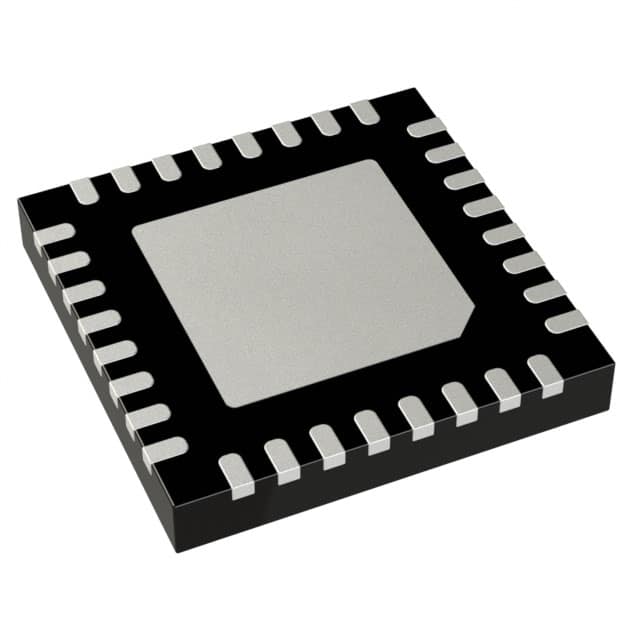
The ADN2814ACPZ is suitable for applications such as SONET OC-1/-3/-12, Fast Ethernet, serial digital interfaces, WDM transponders, and test equipment. It is packaged in a 32-lead LFCSP (5x5 mm) with exposed pad for surface mount assembly. The device is lead-free (Pb free) as per the datasheet.
The operating supply voltage range is 3V to 3.6V, with a typical value of 3.3V.
The ambient operating temperature range is -40°C to +85°C.
It is available in a 32-lead LFCSP (5x5 mm) with exposed pad, also described as 32-WFQFN Exposed Pad, CSP.
The datasheet explicitly states the device is lead-free (Pb free). RoHS3 compliance is listed but unverified.
It supports continuous data rates from 10 Mb/s to 675 Mb/s.
Typical power dissipation is 435 mW.
Input logic is CML, output logic is LVDS with a 1:2 ratio.