

| Distributor | Stock | Pricing | MOQ | PKG | Lead Time | Date Code | On Order Quantity | On Order Delivery | |
|---|---|---|---|---|---|---|---|---|---|
|
2,644 pcs
|
2644 pcs | On Request | 1 | On Request | On Request | On Request | On Request | On Request |
| Category | |
| Manufacturer Name | |
| Channel | |
| Channel Capacitance (CS(off), CD(off)) | |
| Charge Injection | |
| Crosstalk | |
| Current | |
| Mounting Type | |
| Multiplexer | |
| Number of Circuits | |
| On | |
| Operating Temperature | |
| Operating Voltage | |
| Supplier Device Package | |
| Supplier Package | |
| Voltage |
The ADG1438BCPZ-REEL7 is a CMOS analog matrix switch from Analog Devices, designed for applications requiring efficient signal routing. It functions as an 8:1 multiplexer, controlled via a versatile 3-wire serial interface operating at clock rates up to 50 MHz.
Key electrical characteristics include a typical on-resistance of 9.5 Ohms at 25°C, with an on-resistance flatness of 1.6 Ohms. The device supports a wide operating voltage range of ±4.5V to ±16.5V and operates within a temperature range of -40°C to 125°C.
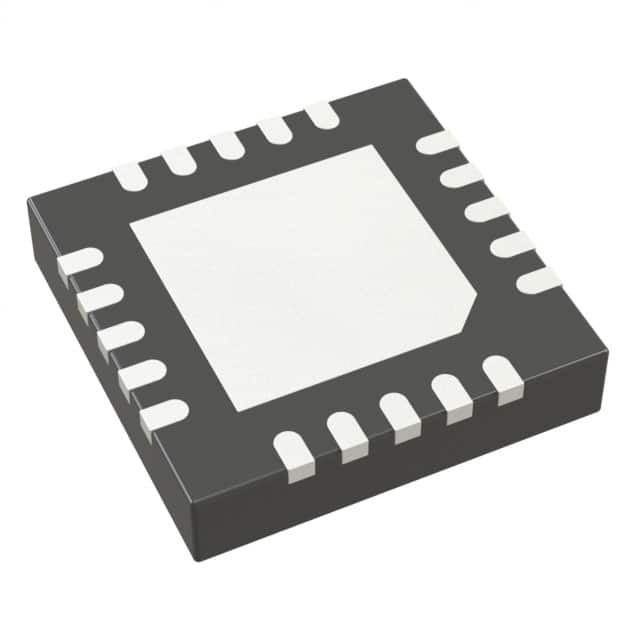
This switch is suitable for various applications such as audio and video routing, data acquisition systems, and automatic test equipment. Its iCMOS construction ensures ultralow power dissipation, making it ideal for battery-powered instruments. The component is housed in a 20-lead LFCSP (4x4 mm) package, suitable for surface mounting.
The ADG1438/ADG1439 series utilizes a serial interface compatible with SPI, QSPI, MICROWIRE, and DSP standards. The SDO output allows for daisy-chaining multiple devices. All channels exhibit break-before-make switching action to prevent momentary shorting during channel transitions.
The typical on-resistance is 11.5 Ohms at 25°C with a flatness of 1.6 Ohms.
The device operates from a dual supply of ±4.5 V to ±16.5 V.
The operating temperature range is -40°C to +125°C (ambient).
It is supplied in a 20-lead LFCSP (4x4 mm) with exposed pad.
RoHS compliance is listed as RoHS3 compliant but is unverified (low confidence).
The typical charge injection is 4 pC.
The typical crosstalk is -70 dB at 1 MHz.