

| Distributor | Stock | Pricing | MOQ | PKG | Lead Time | Date Code | On Order Quantity | On Order Delivery | |
|---|---|---|---|---|---|---|---|---|---|
|
4 pcs
|
4 pcs | On Request | 1 | On Request | On Request | On Request | On Request | On Request |
| Category | |
| Manufacturer Name | |
| Bandwidth | |
| Channel | |
| Channel Capacitance (CS(off), CD(off)) | |
| Charge Injection | |
| Crosstalk | |
| Current | |
| Industrial Grade | |
| Lead Style | |
| Logic Voltage | |
| Mounting Type | |
| Multiplexer | |
| Number of Circuits | |
| On | |
| Operating Temperature | |
| Power Consumption | |
| SVHC Present | |
| Supplier Device Package | |
| Supplier Package | |
| Supply Voltage | |
| Switch Circuit | |
| Switch Time (Ton, Toff) (Max) | |
| Tape & Reel | |
| Voltage |
The Analog Devices ADG1209YRUZ-REEL7 is a monolithic iCMOS analog multiplexer featuring four differential channels. It switches one of four differential inputs to a common differential output, controlled by 2-bit binary address lines and an enable input.
Key electrical specifications include a typical on-resistance of 120 Ohms and a bandwidth of 550MHz. It offers low charge injection (<1 pC) and low off-capacitance (1 pF), making it suitable for data acquisition and sample-and-hold applications. The device supports rail-to-rail operation and is fully specified at ±15 V/+12 V supply ranges, with logic compatible inputs at 3V.
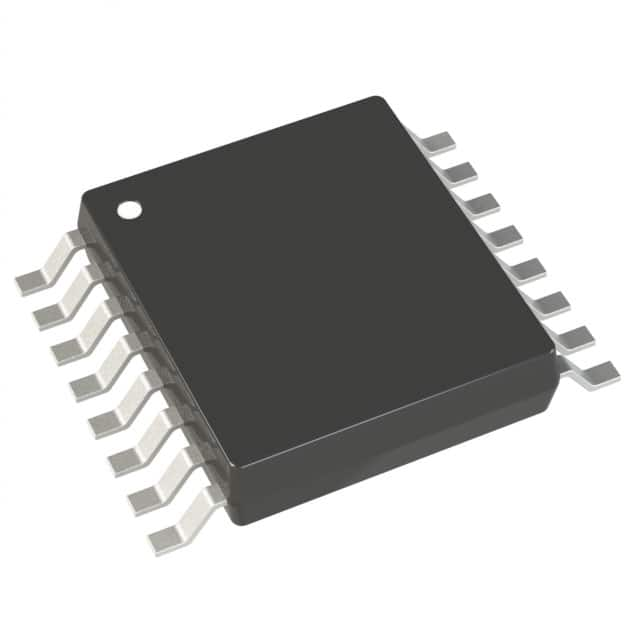
This multiplexer is available in a 16-lead TSSOP surface-mount package. Its typical power consumption is less than 0.03 µW, making it suitable for battery-powered systems. The device operates over a temperature range of -40°C to 125°C (TA).
Applications include audio and video routing, automatic test equipment, data-acquisition systems, battery-powered systems, sample-and-hold systems, and communication systems.
The operating temperature range is -40°C to 125°C (TA).
The ADG1209YRUZ-REEL7 is available in a 16-TSSOP package.
The RoHS status is RoHS3 Compliant.
The typical on-resistance is 120 Ohms.
The bandwidth is 550MHz.
The charge injection is typically less than 1 pC over the full signal range.
The typical power consumption is less than 0.03 µW.