

| Distributor | Stock | Pricing | MOQ | PKG | Lead Time | Date Code | On Order Quantity | On Order Delivery | |
|---|---|---|---|---|---|---|---|---|---|
|
5,000 pcs
|
5000 pcs | On Request | 1 | On Request | On Request | On Request | On Request | On Request | |
|
2,300 pcs
|
2300 pcs | On Request | 1 | On Request | On Request | 24+ | On Request | On Request |
| Category | |
| Manufacturer Name | |
| Contact Plating | |
| Data Rate | |
| Master fclk | |
| Mounting Type | |
| Operating Temperature | |
| Package Quantity | |
| Power Dissipation | |
| Resolution (Bits) | |
| Supplier Device Package | |
| Termination | |
| Termination Style | |
| Tuning Word Width (Bits) | |
| Voltage |
The AD9951YSVZ is a 400 MSPS Direct Digital Synthesizer (DDS) from Analog Devices, incorporating an integrated 14-bit digital-to-analog converter (DAC). It operates from a 1.8 V power supply (1.71 V to 1.96 V range) and features a 32-bit tuning word for precise frequency control. The device includes a phase-locked loop (PLL) REFCLK multiplier (4× to 20×) and an internal oscillator that can be driven by a single crystal.
Key electrical specifications include a phase noise of ≤ -120 dBc/Hz at 1 kHz offset and a spurious-free dynamic range (SFDR) greater than 80 dB at 160 MHz (±100 kHz offset). The DDS core provides a conversion rate of 400,000 kS/s and a data rate of 25 Mbps. Typical power dissipation is 171 mW.
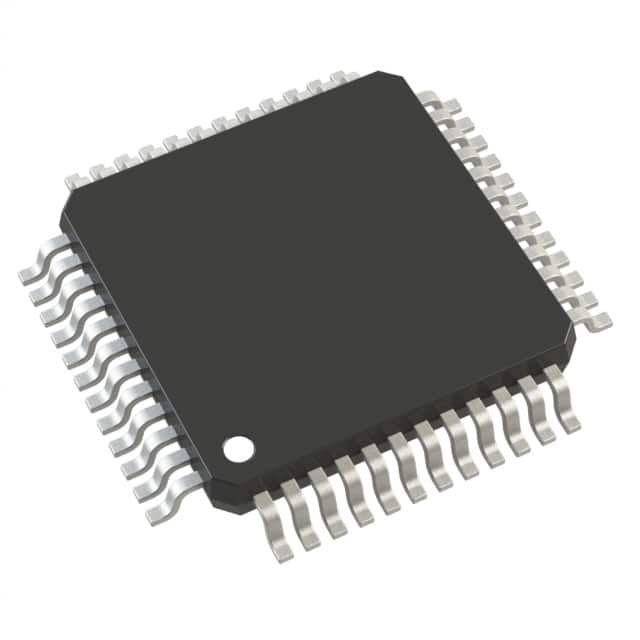
The device supports surface mount mounting and is packaged in a 48-lead TQFP with exposed pad (48-TQFP-EP 7x7). The operating temperature range is -40°C to +105°C. Contact plating is tin, matte, and termination style is SMD/SMT.
This DDS is suitable for applications such as agile local oscillator frequency synthesis, programmable clock generation, and test and measurement equipment. The AD9951YSVZ is listed as RoHS compliant (unverified) and has an MSL of 1 (unverified).
1.71V to 1.96V.
48-lead TQFP with exposed pad (48-TQFP-EP 7x7 mm).
-40°C to +105°C.
Yes, it is listed as RoHS3 Compliant, but this is unverified.
≤ -120 dBc/Hz at 1 kHz offset.
80 dB at 160 MHz (±100 kHz offset).
One.