

| Distributor | Stock | Pricing | MOQ | PKG | Lead Time | Date Code | On Order Quantity | On Order Delivery | |
|---|---|---|---|---|---|---|---|---|---|
|
723,000 pcs
|
723000 pcs | On Request | 1 | On Request | On Request | 20+ | On Request | On Request |
| Category | |
| Manufacturer Name | |
| Architecture | |
| Data Interface | |
| Differential Output | |
| INL | |
| Mounting Type | |
| Number of Bits | |
| Number of D | |
| Operating Temperature | |
| Output Type | |
| Power Dissipation | |
| Reference Type | |
| SVHC Present | |
| Settling Time | |
| Supplier Device Package | |
| Voltage |
The AD9777BSVZRL is a high-performance 16-bit dual digital-to-analog converter (DAC) from Analog Devices featuring a maximum input data rate of 160 MSPS and a DAC update rate of 400 MSPS with 8x interpolation. It belongs to the TxDAC+ series and offers selectable interpolation factors of 2x, 4x, or 8x. The device includes a digital quadrature modulator capable of operating at Fs/2, Fs/4, or Fs/8, enabling image rejection architectures and direct IF transmission for frequencies above 70 MHz.
Key electrical characteristics include a typical settling time of 11 µs, differential current output (unbuffered), and support for external or internal reference. Typical power dissipation is 1.2 W from a single 3.3 V supply (3.1 V to 3.5 V range). SFDR is -73 dBc (2 MHz to 35 MHz), and WCDMA ACPR is 71 dB at 19.2 MHz IF. The device features a parallel data interface with twos complement or straight binary coding.
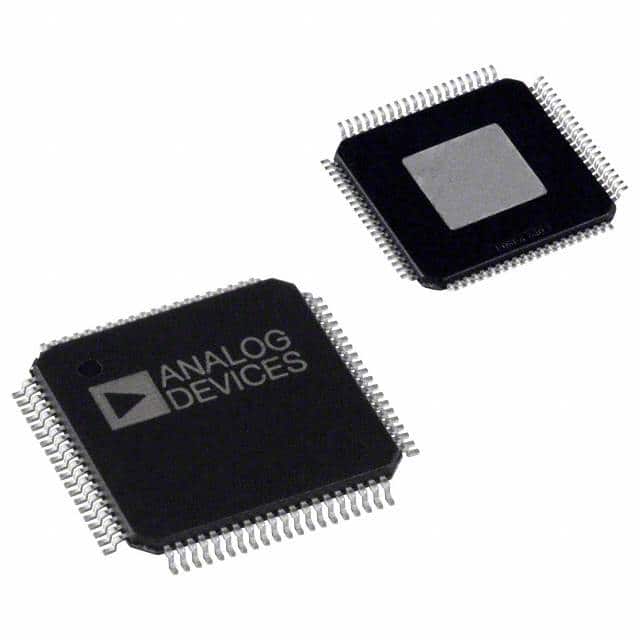
Designed for communications infrastructure, the AD9777BSVZRL is well-suited for 3G, multicarrier GSM, CDMA, broadband wireless, and instrumentation applications. It is housed in an 80-lead TQFP with exposed pad (80-TQFP-EP, 12x12 mm) for improved thermal performance, and operates over the industrial temperature range of -40°C to 85°C. Packaging is surface mount.
3.1 V to 3.5 V (typical 3.3 V).
80-lead TQFP with exposed pad (80-TQFP-EP).
-40°C to 85°C.
Marked as RoHS3 compliant (unverified, low confidence).
16-bit resolution.
160 MSPS (megasamples per second).
Yes, it uses a parallel data interface.