

| Distributor | Stock | Pricing | MOQ | PKG | Lead Time | Date Code | On Order Quantity | On Order Delivery | |
|---|---|---|---|---|---|---|---|---|---|
|
7 pcs
|
7 pcs | On Request | 1 | On Request | On Request | On Request | On Request | On Request |
| Category | |
| Manufacturer Name | |
| Architecture | |
| Configuration | |
| Data Interface | |
| Input Type | |
| Mounting Type | |
| Number of A | |
| Number of Bits | |
| Number of Inputs | |
| Operating Temperature | |
| Power Dissipation | |
| Ratio | |
| Reference Type | |
| SVHC Present | |
| Sampling Rate (Per Second) | |
| Supplier Device Package | |
| Voltage |
The AD976ABR is a high-speed, low-power 16-bit successive approximation register (SAR) analog-to-digital converter (ADC) from Analog Devices. It provides a maximum sampling rate of 200 kSPS and accepts a single-ended analog input voltage range of ±10 V. The device operates from a single 5 V supply and dissipates a maximum of 100 mW.
This ADC features a parallel data interface and includes an internal 2.5 V reference with the option for external reference use. The SAR architecture ensures high accuracy, with integral nonlinearity of ±3 LSB and differential nonlinearity of ±2 LSB, and guarantees no missing codes up to 15 bits. The ADC is factory-calibrated to minimize linearity errors.
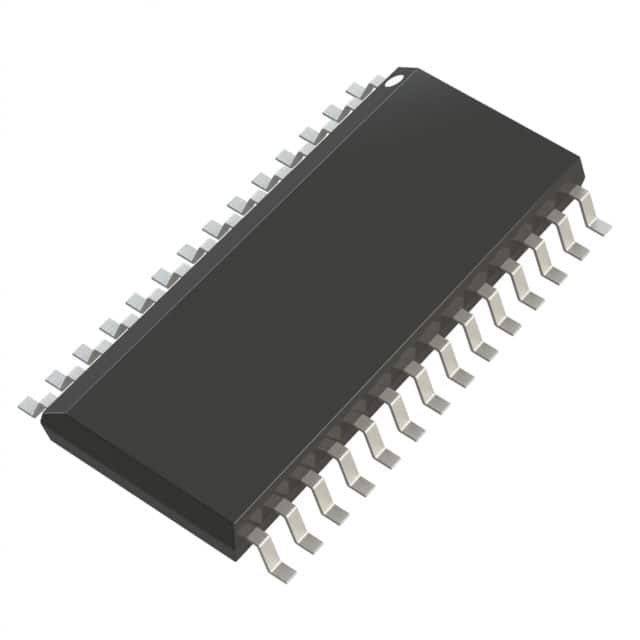
The AD976ABR is packaged in a 28-lead SOIC (0.295-inch body width) and is designed for surface-mount assembly. It operates over the industrial temperature range of -40°C to +85°C. The part is suitable for industrial data acquisition, process control, medical instrumentation, and other precision measurement applications.
The AD976ABR is a 16-bit analog-to-digital converter.
The maximum sampling rate is 200 kSPS (200,000 samples per second).
The device operates from a single 5 V supply.
The analog input range is ±10 V (single-ended).
The AD976ABR is available in a 28-lead SOIC package (0.295 inch, 7.50 mm width).
The operating temperature range is -40°C to +85°C.
The AD976ABR is listed as RoHS3 compliant, but this status is unverified and based on low-confidence data.