

| Distributor | Stock | Pricing | MOQ | PKG | Lead Time | Date Code | On Order Quantity | On Order Delivery | |
|---|---|---|---|---|---|---|---|---|---|
|
6,358 pcs
|
6358 pcs | On Request | 1 | On Request | On Request | On Request | On Request | On Request |
| Category | |
| Manufacturer Name | |
| Differential | |
| Divider | |
| Frequency | |
| Input | |
| Input Type | |
| Mounting Type | |
| Number of Circuits | |
| Operating Temperature | |
| Output | |
| PLL | |
| Ratio | |
| Supplier Device Package | |
| Supplier Package | |
| Type | |
| Voltage |
The AD9520-0BCPZ is a multi-output clock distribution device from Analog Devices, incorporating a phase-locked loop (PLL) and an on-chip Voltage Controlled Oscillator (VCO). The integrated VCO tunes from 2.53 GHz to 2.95 GHz, providing a maximum output frequency of 2.95 GHz. This device supports various input references, including CMOS, LVDS, and LVPECL up to 250 MHz, as well as crystals from 16.62 MHz to 33.3 MHz.
It offers twelve 1.6 GHz LVPECL outputs, which can be individually configured as two CMOS outputs for frequencies up to 250 MHz. The AD9520-0BCPZ boasts low phase noise and additive output jitter as low as 225 fs rms, with channel-to-channel skew under 16 ps. It operates over a temperature range of -40°C to 85°C and is supplied in a 64-lead LFCSP package.
Key features include automatic/manual reference holdover and switchover modes, glitch-free switching, and digital or analog lock detect. The device supports SPI and I²C compatible serial control ports, with configuration settings storable in nonvolatile EEPROM. Applications include clock generation and translation for high-speed communication systems like SONET and Ethernet, as well as clocking for ADCs, DACs, and wireless transceivers.
The operating voltage range is 3.135 V to 3.465 V.
The operating temperature range is -40°C to 85°C.
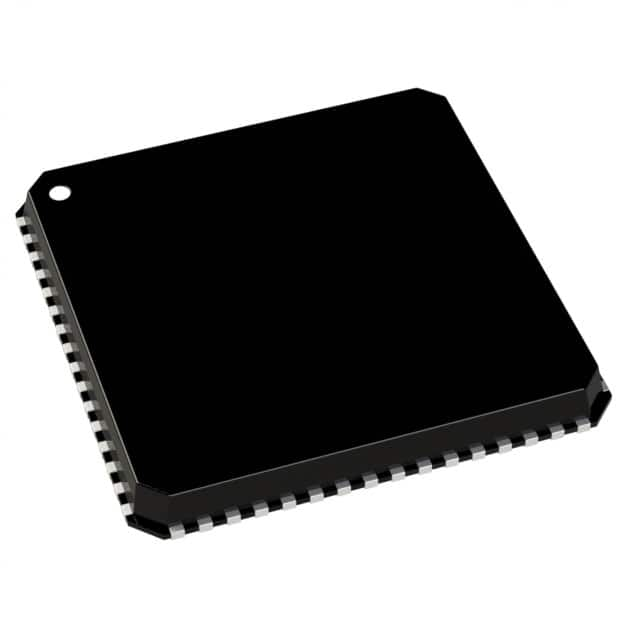
It is available in a 64-VFQFN Exposed Pad, CSP package (64-LFCSP-VQ, 9x9 mm) for surface mount mounting.
The RoHS status is listed as RoHS3 Compliant, but this value is unverified and should be treated as low confidence.
It supports CMOS and LVPECL output types.
The maximum LVPECL output frequency is 1.6 GHz.
The additive output jitter is as low as 225 fs rms.