

| Distributor | Stock | Pricing | MOQ | PKG | Lead Time | Date Code | On Order Quantity | On Order Delivery | |
|---|---|---|---|---|---|---|---|---|---|
|
3,000 pcs
|
3000 pcs | On Request | 1 | On Request | On Request | On Request | On Request | On Request |
| Category | |
| Manufacturer Name | |
| Differential | |
| Divider | |
| Frequency | |
| Input | |
| Input Frequency | |
| Lead Spacing | |
| Lead Style | |
| Mounting Type | |
| Number of Circuits | |
| Operating Temperature | |
| Output | |
| PLL | |
| Power Consumption | |
| Ratio | |
| SVHC Present | |
| Supplier Device Package | |
| Tape & Reel | |
| Termination Style | |
| Type | |
| Voltage |
The AD809BR-REEL7 is a clock/frequency synthesizer designed to generate a 155.52 MHz output clock from either a 19.44 MHz or 9.72 MHz reference input. It incorporates a phase-locked loop (PLL) and supports differential inputs and outputs with a 2:1 input-to-output ratio.
Key specifications include operation from a single supply of 4.5V to 5.5V (positive) or -5.2V (negative), typical power consumption of 90 mW, and output jitter of 2.0 degrees RMS typical. The device operates over a -40°C to 85°C temperature range and features a jitter transfer bandwidth of 200 kHz typical.
The AD809BR-REEL7 is suitable for SONET/SDH and Fiber in the Loop systems requiring a low-jitter 155.52 MHz bit clock. The on-chip VCO eliminates external components for frequency synthesis, though loop dynamics can be adjusted with an external damping capacitor. The design ensures output frequency drifts low (approximately 20%) if the input signal is lost.
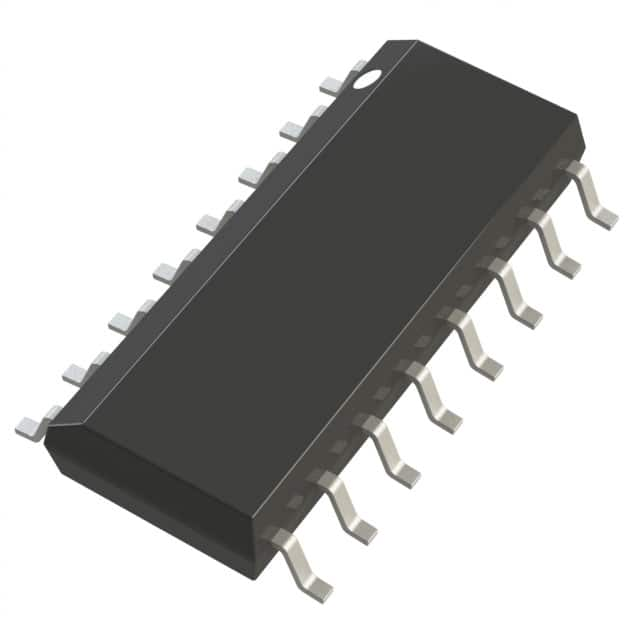
The device is supplied in a 16-pin narrow SOIC (SOIC-16) with Gull Wing leads for surface mounting. Tape and reel packaging facilitates automated assembly processes.
The positive supply voltage range is 4.5 V to 5.5 V. A negative supply of -5.2 V typical is also supported.
The device is packaged in a 16-SOIC (0.154", 3.90mm Width) surface mount package, also known as 16-SOIC (narrow).
The operating temperature range is -40°C to 85°C.
It is listed as RoHS3 compliant, but this is unverified and should be confirmed with the manufacturer or compliance documents.
The output frequency is 155.52 MHz with typical jitter of 2.0° RMS and maximum jitter of 2.9° RMS.
The device accepts either 19.44 MHz or 9.72 MHz reference inputs for ×8 or ×16 synthesis.
Typical power consumption is 90 mW.