

| Distributor | Stock | Pricing | MOQ | PKG | Lead Time | Date Code | On Order Quantity | On Order Delivery | |
|---|---|---|---|---|---|---|---|---|---|
|
3,700 pcs
|
3700 pcs | On Request | 1 | On Request | On Request | On Request | On Request | On Request |
| Category | |
| Manufacturer Name | |
| Architecture | |
| Configuration | |
| Data Interface | |
| Input Type | |
| Mounting Type | |
| Number of A | |
| Number of Bits | |
| Number of Inputs | |
| Number of Pins | |
| Operating Temperature | |
| Ratio | |
| Reference Type | |
| Sampling Rate (Per Second) | |
| Supplier Device Package | |
| Supplier Package | |
| Voltage |
The AD7871JNZ is a complete 14-bit successive approximation (SAR) analog-to-digital converter (ADC) manufactured by Analog Devices. It integrates a track-and-hold amplifier, a 14-bit SAR ADC, an internal 3V buried Zener reference, and versatile interface logic on a single monolithic chip.
With a sampling rate of 83 kSPS, the AD7871JNZ achieves a typical signal-to-noise ratio of 80 dB at 10 kHz input frequency. It accepts a bipolar input voltage range of ±3V and operates from dual ±5V power supplies. The converter offers both SPI and parallel data interfaces, providing flexibility for connection to microprocessors and DSPs. Typical power dissipation is 50 mW.
The device includes an internal clock that can be overridden for synchronization, and a 57 ns typical data access time. The ADC architecture is SAR, with a single-ended input and a sample-and-hold to ADC ratio of 1:1. The internal reference simplifies external circuitry.
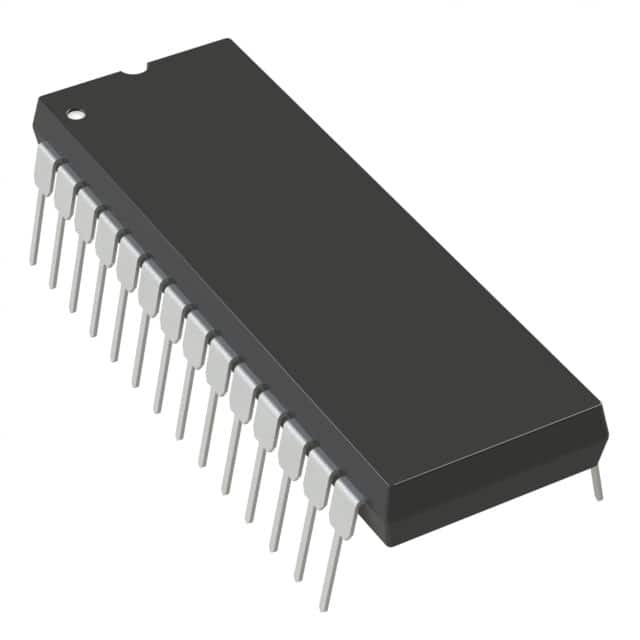
The AD7871JNZ is available in a 28-pin PDIP package (0.600" body width, 15.24mm), suitable for through-hole mounting. It operates over a temperature range of 0°C to 70°C. The part is specified as RoHS3 compliant (low confidence) and MSL level 1 (unlimited).
±5V dual supply.
28-pin PDIP (28-DIP) with 0.600" body width and 15.24mm lead pitch.
0°C to 70°C.
It is listed as RoHS3 compliant, but this is unverified. Check with manufacturer for confirmation.
14 bits.
83 kSPS.
SPI and parallel.