

| Distributor | Stock | Pricing | MOQ | PKG | Lead Time | Date Code | On Order Quantity | On Order Delivery | |
|---|---|---|---|---|---|---|---|---|---|
|
1,000 pcs
|
1000 pcs | On Request | 1 | On Request | On Request | 17+ | On Request | On Request |
| Category | |
| Manufacturer Name | |
| Architecture | |
| Configuration | |
| Data Interface | |
| Input Type | |
| Mounting Type | |
| Number of A | |
| Number of Bits | |
| Number of Inputs | |
| Operating Temperature | |
| Ratio | |
| Reference Type | |
| Sampling Rate (Per Second) | |
| Supplier Device Package | |
| Voltage |
The AD7667ASTZRL is a 16-bit, 1 MSPS, charge redistribution SAR analog-to-digital converter from Analog Devices. It operates from a single 5 V power supply and includes a high-speed 16-bit sampling ADC, an internal conversion clock, an internal 2.5 V reference with a typical drift of 3 ppm/°C, error correction circuits, and both serial and parallel system interface ports.
The ADC offers three operating modes: Warp mode for maximum throughput at 1 MSPS, Normal mode for asynchronous applications at 800 kSPS, and Impulse mode for low power applications at 666 kSPS. It achieves a minimum signal-to-noise ratio of 88 dB and a maximum total harmonic distortion of -96 dB with a 20 kHz input. The analog input voltage range is 0 V to 2.5 V.
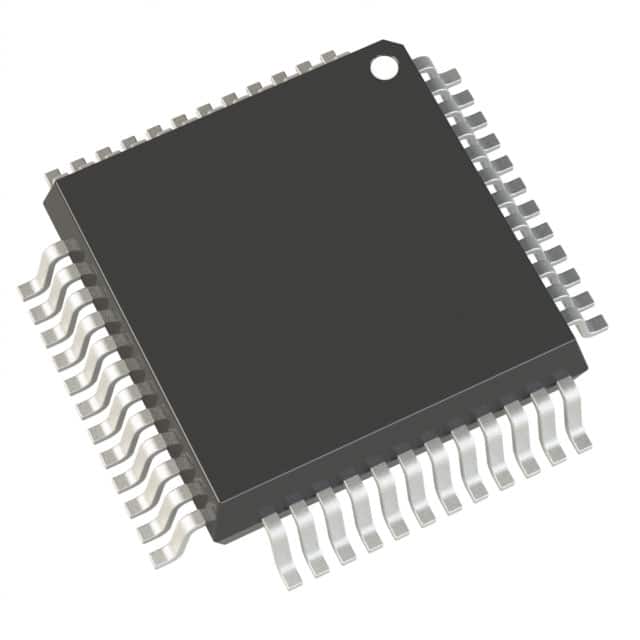
The device is available in a 48-lead LQFP package (7x7 mm) for surface mount assembly. It supports SPI, parallel, and DSP-compatible data interfaces. Power dissipation is 87 mW typical at 666 kSPS without the internal reference, scaling down to 130 µW at 1 kSPS for battery-powered applications.
The AD7667ASTZRL has a resolution of 16 bits.
The maximum sampling rate is 1 MSPS in Warp mode.
The operating temperature range is -40°C to 85°C.
The AD7667ASTZRL is available in a 48-LQFP (7x7 mm) surface mount package.
The supply voltage is 5 V nominal.
The AD7667ASTZRL supports SPI, parallel, and DSP interfaces.
Typical power dissipation is 87 mW at 666 kSPS without the internal reference, and 133 mW at 1 MSPS with the internal reference.