

| Distributor | Stock | Pricing | MOQ | PKG | Lead Time | Date Code | On Order Quantity | On Order Delivery | |
|---|---|---|---|---|---|---|---|---|---|
|
11 pcs
|
11 pcs | On Request | 1 | On Request | On Request | 23+ | On Request | On Request | |
|
2 pcs
|
2 pcs | On Request | 1 | On Request | On Request | On Request | On Request | On Request |
| Category | |
| Manufacturer Name | |
| Architecture | |
| Configuration | |
| Data Interface | |
| Features | |
| Input Type | |
| Mounting Type | |
| Number of A | |
| Number of Bits | |
| Number of Inputs | |
| Operating Temperature | |
| Ratio | |
| Reference Type | |
| Sampling Rate (Per Second) | |
| Supplier Device Package | |
| Voltage |
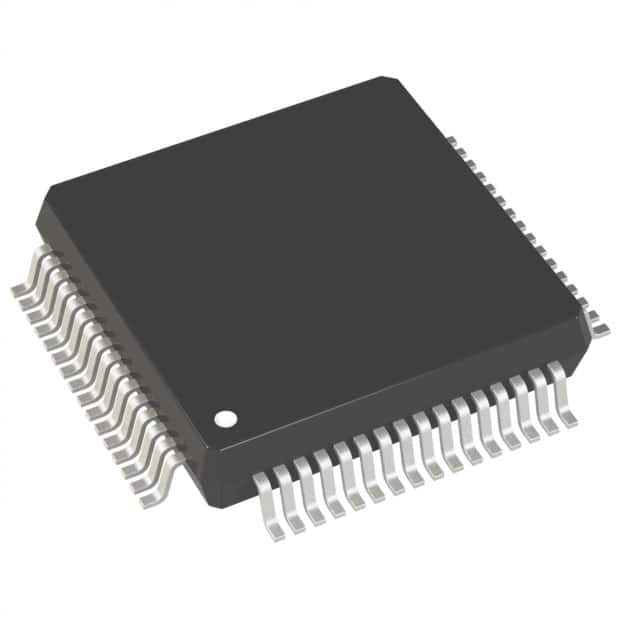
AD7656BSTZ is a 16-bit, 250 kSPS analog-to-digital converter (ADC) from Analog Devices, designed on the iCMOS industrial CMOS process. It integrates six independent successive approximation (SAR) ADCs in a single 64-lead LQFP package, supporting simultaneous sampling of six single-ended analog inputs.
The ADC features true bipolar analog inputs with pin- or software-selectable ranges of ±10 V and ±5 V. It operates from a 5 V supply and typically dissipates 140 mW at 250 kSPS. The part provides 86.5 dB SNR at a 50 kHz input frequency and includes an on-chip reference and reference buffers.
Data transfer can be performed through parallel, serial (SPI/QSPI/MICROWIRE/DSP-compatible), or daisy-chain interface modes. The AD7656BSTZ is intended for applications such as power-line monitoring, instrumentation and control systems, and multi-axis positioning systems. It is rated for the -40°C to +85°C industrial temperature range and comes in a surface-mount 64-LQFP (10x10) package.
The device operates from a 5 V supply.
It is available in a surface-mount 64-LQFP package (64-LQFP 10x10 mm).
-40°C to 85°C.
The part is listed as RoHS3 compliant in the existing database, but this status is unverified.
16-bit resolution and 250 kSPS sampling rate.
Six single-ended analog inputs with simultaneous sampling capability.
True bipolar ranges of ±10 V and ±5 V, selectable via pins or software.