

| Distributor | Stock | Pricing | MOQ | PKG | Lead Time | Date Code | On Order Quantity | On Order Delivery | |
|---|---|---|---|---|---|---|---|---|---|
|
5,797 pcs
|
5797 pcs | On Request | 1 | On Request | On Request | 07+ | On Request | On Request | |
|
3,000 pcs
|
3000 pcs | On Request | 1 | On Request | On Request | On Request | On Request | 2026-02-23 21:33:16 |
| Category | |
| Manufacturer Name | |
| AEC Qualified | |
| Architecture | |
| Automotive Grade | |
| Configuration | |
| Data Interface | |
| Industrial Grade | |
| Input Type | |
| Lead Style | |
| Medical Grade | |
| Military Grade | |
| Mounting Type | |
| Number of A | |
| Number of Bits | |
| Number of Inputs | |
| Operating Temperature | |
| Ratio | |
| Reference Type | |
| SVHC Present | |
| Sampling Rate (Per Second) | |
| Supplier Device Package | |
| Voltage |
The AD7579KN is a 10-bit successive approximation register (SAR) analog-to-digital converter from Analog Devices. It features two differential input channels and a parallel data interface for easy connection to microcontrollers or digital systems. The device includes an internal sample-and-hold circuit and requires an external voltage reference.
With a sampling rate of 50k samples per second, this ADC is suitable for low-to-medium speed data acquisition applications. It operates from a single 5V analog supply and is specified over the commercial temperature range of 0°C to 70°C. The SAR architecture provides fast conversion with no pipeline delay.
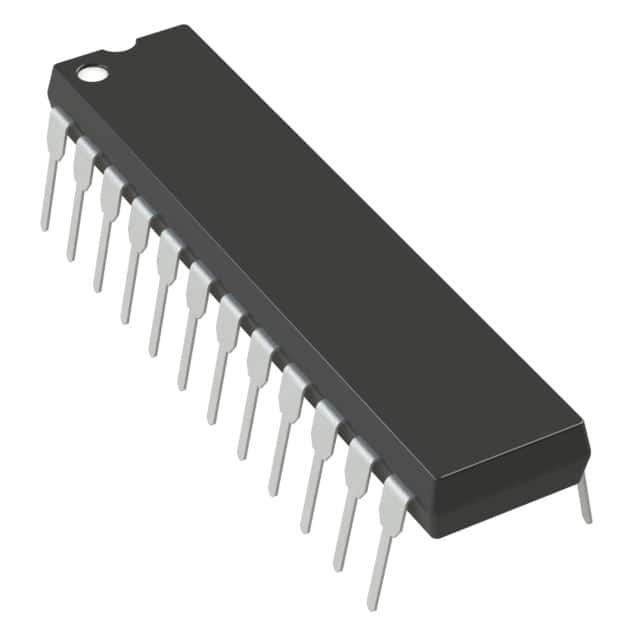
The AD7579KN is housed in a 24-pin plastic DIP package (24-DIP, 0.300 inch body width) and is designed for through-hole mounting. The supplier device package is 24-PDIP. This package is ideal for prototyping and applications where board space is not critical.
The AD7579KN has a resolution of 10 bits.
It has 2 differential input channels.
The sampling rate is 50k samples per second.
The operating temperature range is 0°C to 70°C.
It comes in a 24-DIP (0.300", 7.62mm) package, also known as 24-PDIP.
RoHS compliance is listed as RoHS3 compliant but is unverified.
It uses successive approximation register (SAR) architecture.