

| Distributor | Stock | Pricing | MOQ | PKG | Lead Time | Date Code | On Order Quantity | On Order Delivery | |
|---|---|---|---|---|---|---|---|---|---|
|
10 pcs
|
10 pcs | On Request | 1 | On Request | On Request | 1107 | On Request | On Request |
| Category | |
| Manufacturer Name | |
| Architecture | |
| Data Interface | |
| Differential Output | |
| INL | |
| Mounting Type | |
| Number of Bits | |
| Number of D | |
| Operating Temperature | |
| Output Type | |
| Reference Type | |
| Settling Time | |
| Supplier Device Package | |
| Voltage |
The AD7247KRZ is a 12-bit dual digital-to-analog converter (DAC) from Analog Devices / Maxim Integrated. It provides two buffered voltage output channels with a parallel data interface, making it suitable for multi-channel analog output applications. The device uses an R-2R ladder architecture and supports both external and internal voltage references.
Key electrical characteristics include a 10 µs settling time, integral nonlinearity of ±0.5 LSB (max), and differential nonlinearity of ±0.9 LSB (max). The device operates from a 15 V supply and is rated for an operating temperature range of -40°C to 85°C.
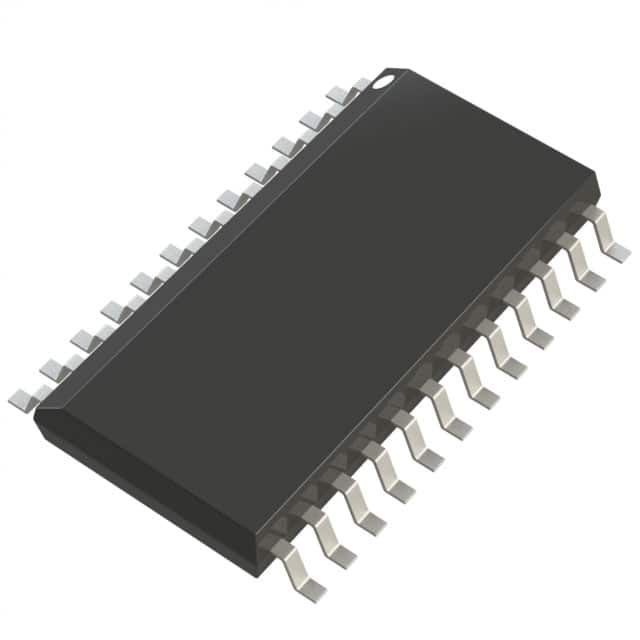
The AD7247KRZ is available in a 24-SOIC (0.295", 7.50mm width) surface-mount package, with a supplier device package designation of 24-SOIC. This package is suitable for automated assembly in a variety of industrial and instrumentation applications.
As a dual-channel DAC, the AD7247KRZ can be used in systems requiring multiple analog outputs, such as process control, test equipment, and data acquisition systems. The parallel interface allows for straightforward connection to microcontrollers and digital signal processors.
The AD7247KRZ has a resolution of 12 bits.
The AD7247KRZ contains 2 D/A converters.
The settling time is 10 µs.
The output type is Voltage - Buffered.
The operating temperature range is -40°C to 85°C.
The AD7247KRZ is available in a 24-SOIC (0.295", 7.50mm Width) surface-mount package.
The AD7247KRZ is marked as RoHS3 compliant, though this is unverified low-confidence data.