

| Distributor | Stock | Pricing | MOQ | PKG | Lead Time | Date Code | On Order Quantity | On Order Delivery | |
|---|---|---|---|---|---|---|---|---|---|
|
2,356 pcs
|
2356 pcs | On Request | 1 | On Request | On Request | On Request | On Request | On Request |
| Category | |
| Manufacturer Name | |
| Function | |
| Height | |
| Input Voltage | |
| Length | |
| Noise | |
| Number of Bits | |
| Supplier Device Package | |
| Width |
The AD632TH is a monolithic four-quadrant analog multiplier/divider from Analog Devices, internally trimmed to provide ±0.5% maximum multiplying error at +25°C without external adjustments. The transfer function is [(X1 − X2)(Y1 − Y2)/10] + Z2, with all inputs (X, Y, Z) being differential and high impedance. The device offers a typical noise of 90 µV rms over 10 Hz to 10 kHz and operates from a nominal 12 V supply with a typical supply current of 6 mA.
Designed for high-quality analog signal processing, the AD632TH is suitable for applications such as differential ratio computation, algebraic function synthesis, and voltage-controlled oscillators. The part is specified over the full military temperature range of -55°C to +125°C.
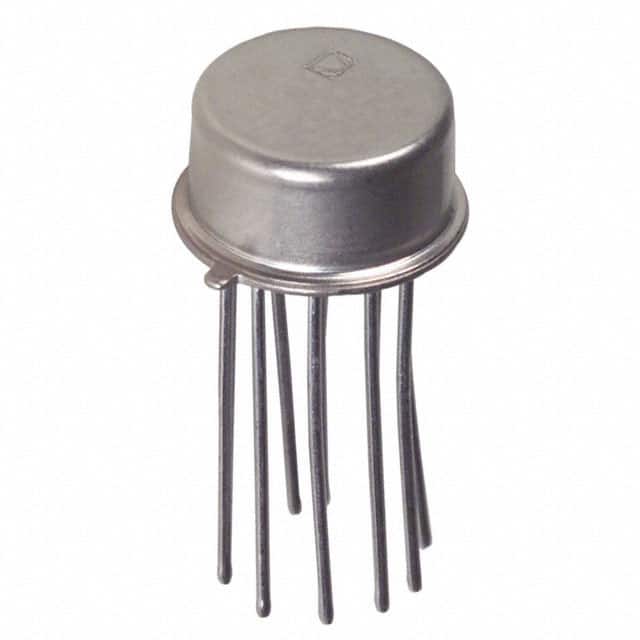
The AD632TH is packaged in a TO-100-10 metal can package, with bulk packaging. The package dimensions are 9.4 mm × 9.4 mm × 4.7 mm maximum. The device is pin-for-pin compatible with the industry-standard AD532 but offers improved specifications and a fully differential Z input.
The RoHS compliance status is conflicting: the database indicates RoHS3 Compliant, but the manufacturer page lists RoHS N (Non-compliant). This information is unverified and should be confirmed with the manufacturer.
The AD632TH is available in a TO-100-10 metal can package.
The AD632TH operates from -55°C to +125°C.
The nominal input voltage is 12 V.
The AD632TH is a 4-quadrant analog multiplier/divider.
At +25°C, the maximum multiplying error is ±0.5% for the AD632B grade. Over the full temperature range of -55°C to +125°C, the maximum error is ±1.0% for the AD632T grade.
The transfer function is [(X1 − X2)(Y1 − Y2)/10] + Z2.