

| Distributor | Stock | Pricing | MOQ | PKG | Lead Time | Date Code | On Order Quantity | On Order Delivery | |
|---|---|---|---|---|---|---|---|---|---|
|
2,144 pcs
|
2144 pcs | On Request | 1 | On Request | On Request | On Request | On Request | On Request | |
|
2,100 pcs
|
2100 pcs | On Request | 1 | On Request | On Request | 24+ | On Request | On Request |
| Category | |
| Manufacturer Name | |
| Architecture | |
| Configuration | |
| Data Interface | |
| Input Type | |
| Lead Style | |
| Mounting Type | |
| Number of A | |
| Number of Bits | |
| Number of Inputs | |
| Operating Temperature | |
| Power Dissipation | |
| Reference Type | |
| SVHC Present | |
| Supplier Device Package | |
| Voltage |
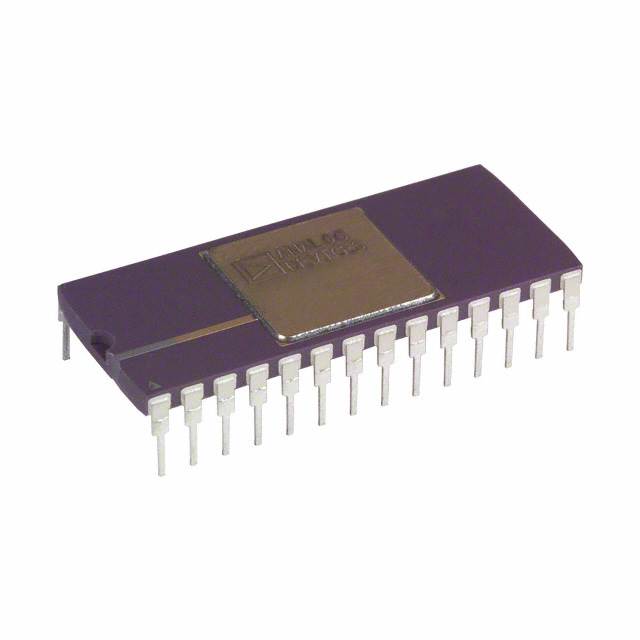
The AD574ATD is a complete 12-bit successive approximation (SAR) analog-to-digital converter from Analog Devices / Maxim Integrated. It offers 12-bit resolution with a maximum linearity error of ±1 LSB at +25°C and guarantees no missing codes down to 11 bits over the full temperature range. The device supports both unipolar (0 V to +10 V, 0 V to +20 V) and bipolar (-5 V to +5 V, -10 V to +10 V) analog input ranges, with input impedance of 3 kΩ / 5 kΩ / 7 kΩ for the 10 V span and 6 kΩ / 10 kΩ / 14 kΩ for the 20 V span.
The ADC operates from three supply rails: VLOGIC (4.5 V to 5.5 V), VCC (11.4 V to 16.5 V), and VEE (-16.5 V to -11.4 V), with typical power dissipation ranging from 390 mW to 725 mW. It includes an internal 10.0 V reference (9.98 V min, 10.02 V max) and also supports an external reference. The parallel data interface provides fast and straightforward connection to microprocessors and digital systems.
The AD574ATD is housed in a 28-lead ceramic dual-in-line package (28-CDIP, 0.600" body width, 15.24 mm pitch) and is designed for through-hole mounting. It is specified for the extended industrial temperature range of -55°C to +125°C, making it suitable for harsh environment applications.
The AD574ATD has a resolution of 12 bits.
The operating temperature range is -55°C to +125°C.
The AD574ATD is housed in a 28-CDIP (0.600", 15.24mm) through-hole package.
Unipolar: 0 V to +10 V and 0 V to +20 V. Bipolar: -5 V to +5 V and -10 V to +10 V.
Yes, it includes an internal 10.0 V reference (9.98 V min, 10.02 V max) and also supports an external reference.
The data interface is parallel.
The architecture is successive approximation (SAR).