

| Distributor | Stock | Pricing | MOQ | PKG | Lead Time | Date Code | On Order Quantity | On Order Delivery | |
|---|---|---|---|---|---|---|---|---|---|
|
2,333 pcs
|
2333 pcs | On Request | 1 | On Request | On Request | On Request | On Request | On Request |
| Category | |
| Manufacturer Name | |
| Architecture | |
| Data Interface | |
| Differential Output | |
| INL | |
| Mounting Type | |
| Number of Bits | |
| Number of D | |
| Operating Temperature | |
| Output Type | |
| Power Dissipation | |
| Reference Type | |
| SVHC Present | |
| Settling Time | |
| Supplier Device Package | |
| Supplier Package | |
| Voltage |
The AD5541AR is a single 16-bit digital-to-analog converter (DAC) from Analog Devices with a voltage output and serial interface. It operates from a single 2.7V to 5.5V supply and provides a full 16-bit monotonic performance. The device uses an R-2R architecture with an unbuffered output capable of driving 60 kΩ loads directly, achieving a typical settling time of 1 µs. Power dissipation is low at 0.625 mW.
Key electrical characteristics include an integral nonlinearity (INL) of ±0.5 LSB (per datasheet typical 1 LSB) and differential nonlinearity (DNL) of ±0.5 LSB maximum, low glitch energy of 1.1 nV-sec, and 5 kV HBM ESD rating. The DAC output range is 0 V to VREF with an external reference. Interface options include SPI, QSPI, and MICROWIRE-compatible standards.
The AD5541AR is suitable for applications such as digital gain and offset adjustment, automatic test equipment, data acquisition systems, and industrial process control. It is available in an 8-SOIC (0.154" width) surface-mount package and specified for operation from -40°C to +85°C.
The AD5541AR is a 16-bit digital-to-analog converter.
The supply voltage range is 2.7V to 5.5V.
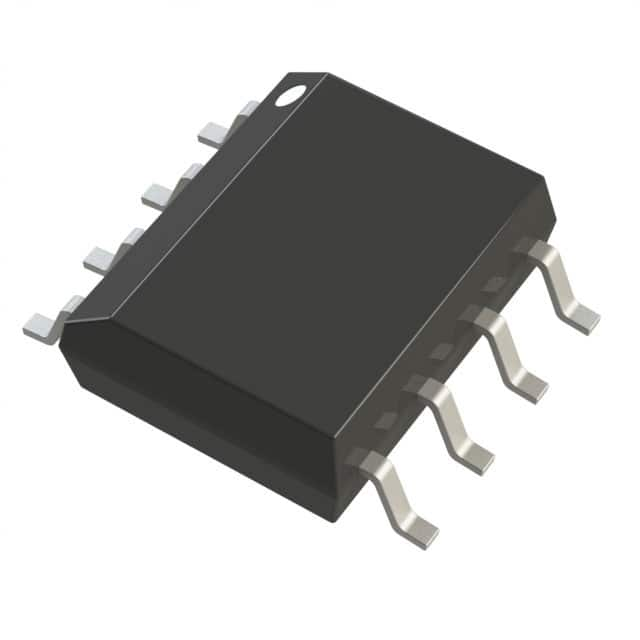
It is available in an 8-SOIC (0.154", 3.90mm Width) surface-mount package.
The operating temperature range is -40°C to +85°C per the datasheet.
The part is listed as RoHS3 compliant but this has not been verified; confirm with the manufacturer.
The typical settling time is 1 µs.
It uses SPI and DSP compatible serial interfaces.