

| Distributor | Stock | Pricing | MOQ | PKG | Lead Time | Date Code | On Order Quantity | On Order Delivery | |
|---|---|---|---|---|---|---|---|---|---|
|
250 pcs
|
250 pcs | On Request | 1 | On Request | On Request | On Request | On Request | On Request |
| Category | |
| Manufacturer Name | |
| Lead Style | |
| Mounting Type | |
| Number of Gates | |
| Number of I/O | |
| Operating Temperature | |
| Supplier Device Package | |
| Voltage |
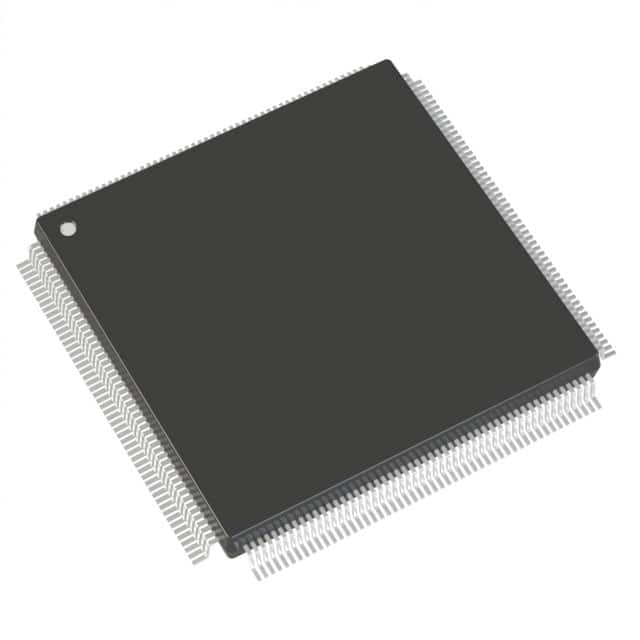
The A3P125-PQG208I from Microchip Technology is a ProASIC3 series Field Programmable Gate Array (FPGA). This component features 125,000 logic gates and provides 133 input/output (I/O) pins, making it suitable for a variety of embedded applications.
Designed for flexibility, the A3P125-PQG208I operates with a supply voltage between 1.425V and 1.575V. It has a total RAM bit count of 36,864 and can function across an operating temperature range of -40°C to 100°C (TJ).
The device is packaged in a 208-pin Quad Flat Package (QFP) with surface mount technology. The package dimensions are 28x28mm, and it comes in a tray. The FPGA is programmable, offering engineers the ability to configure custom hardware functions after manufacturing.
This FPGA is ideal for applications requiring parallel processing, high-speed computing, and custom hardware acceleration. Its reprogrammability allows for faster development cycles and design flexibility compared to ASICs.
| Qty | Low | High |
|---|---|---|
| 1+ | $22.15 | $22.15 |
Estimated market price range - modelled values for guidance only, not live distributor offers.
The A3P125-PQG208I FPGA has 125,000 gates.
The A3P125-PQG208I has 133 I/O pins.
The A3P125-PQG208I operates from -40°C to 100°C.
The supply voltage for the A3P125-PQG208I is between 1.425V and 1.575V.
The A3P125-PQG208I is supplied in a 208-BFQFP package.
The Moisture Sensitivity Level (MSL) for the A3P125-PQG208I is Level 1.
A Field-Programmable Gate Array (FPGA) is a programmable semiconductor device that engineers can configure after manufacturing to perform custom hardware functions. Unlike CPUs or GPUs, FPGAs process data in parallel, making them ideal for high-speed computing, AI acceleration, telecommunications, aerospace, industrial automation, and embedded systems.