

| Distributor | Stock | Pricing | MOQ | PKG | Lead Time | Date Code | On Order Quantity | On Order Delivery | |
|---|---|---|---|---|---|---|---|---|---|
|
525 pcs
|
525 pcs | On Request | 1 | On Request | On Request | On Request | On Request | On Request |
| Category | |
| Manufacturer Name | |
| Count Rate | |
| Direction | |
| Latch-up Performance | |
| Logic Type | |
| Mounting Type | |
| Number of Bits per Element | |
| Number of Elements | |
| Operating Temperature | |
| Reset | |
| SVHC Present | |
| Supplier Device Package | |
| Trigger Type | |
| Voltage |
The 74HC393N,652 is a dual 4-stage binary ripple counter manufactured by NXP Semiconductors. Each counter includes a clock input (nCP) and an overriding asynchronous master reset input (nMR), with four buffered parallel outputs (nQ0 to nQ3). The counter advances on the HIGH-to-LOW transition of the clock input. A HIGH signal on the master reset input clears the counter stages and forces the outputs LOW, regardless of the clock state.
This component features a wide supply voltage range from 2.0 V to 6.0 V and offers CMOS low power dissipation with high noise immunity. It complies with JEDEC standards JESD8C (2.7 V to 3.6 V) and JESD7A (2.0 V to 6.0 V). The input levels are CMOS for the 74HC393 variant and TTL for the 74HCT393 variant. ESD protection is provided, exceeding 2000 V for HBM and 1000 V for CDM.
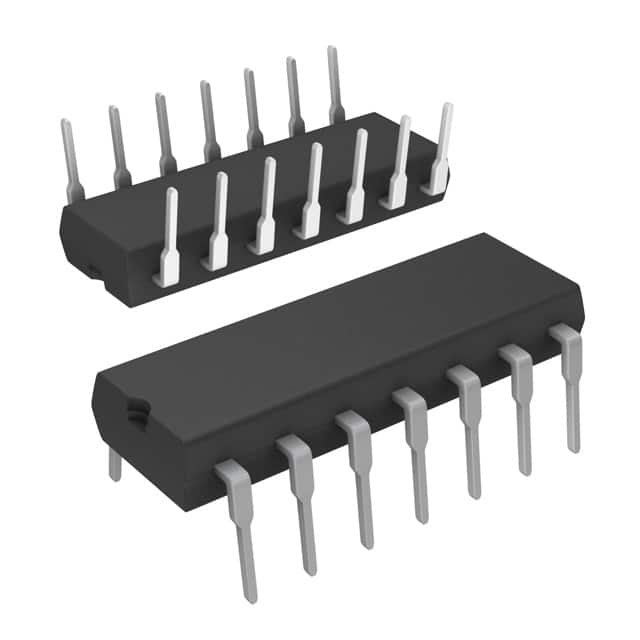
The 74HC393N,652 is available in a 14-DIP package and is designed for through-hole mounting. It operates within a temperature range of -40°C to +125°C. The device contains two independent 4-bit binary counters, each with individual clocks and master resets, allowing for division by any binary module up to 2^8 within a single package.
| Qty | Low | High |
|---|---|---|
| 1+ | $0.50 | $0.50 |
Estimated market price range - modelled values for guidance only, not live distributor offers.
The supply voltage range is 2.0 V to 6.0 V.
The operating temperature range is -40 °C to +125 °C.
It comes in a 14-DIP (0.300", 7.62mm) through-hole package.
The maximum count rate is 107 MHz.
It uses negative-edge triggering.
The reset is asynchronous.
Each element has 4 bits.