

| Category | |
| Manufacturer Name | |
| Actuator Type | |
| Approval Agency | |
| Breaker Type | |
| Current Rating (Amps) | |
| Insulation Resistance | |
| Mounting Type | |
| Number of Poles | |
| Rated Current | |
| Terminal Type | |
| Voltage Rating | |
| Weight |
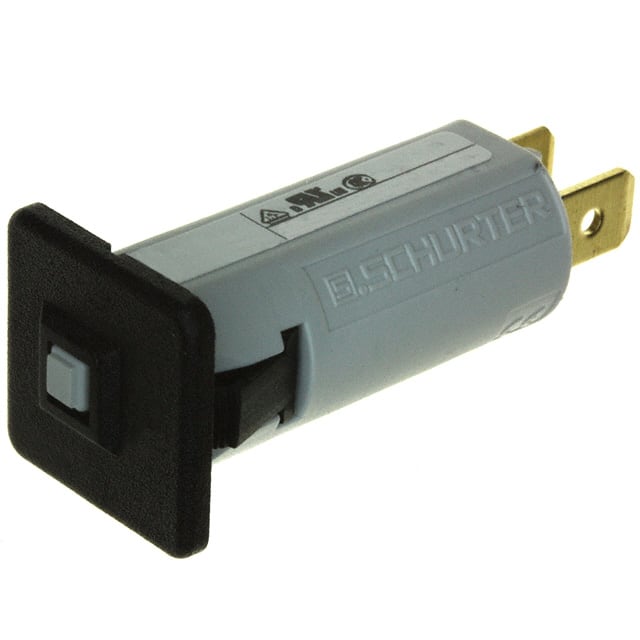
The Schurter Inc. 4404.006 is a thermal circuit breaker designed for equipment protection. It is a single-pole device with a snap-in panel mount design, suitable for panel thicknesses from 0.8 to 2.0 mm. This circuit breaker has a rated current of 7A and can operate at AC voltages up to 240V and DC voltages up to 48/32V.
Key technical specifications include a conditional short circuit capacity of 2 kA (IEC and UL/CSA), and a degree of protection of IP40 on the front side. The device offers a minimum endurance of 50 switching cycles under IEC conditions and typical endurance of 2500 switching cycles for lower current ratings (3-8A) and 6000 switching cycles for higher ratings (10-16A) at a power factor of 0.9.
It operates within a temperature range of -5°C to 60°C for most current ratings, with a specific range of -5°C to 50°C for the 4A variant. The circuit breaker features quick connect terminals (6.3 x 0.8 mm) and a push-to-reset actuator. It is designed according to various product standards including IEC 60934, UL 1077, CSA C22.2 No. 235, and GB 17701.
Applications for this circuit breaker include power supplies, uninterruptible power supplies, power tools, industrial appliances, HVAC systems, and household appliances. It is compliant with RoHS3, REACH Unaffected, and has an MSL of 1.
The 4404.006 is rated for 240 VAC and 48/32 VDC.
The 4404.006 is a 7A thermal circuit breaker.
For currents 5-16 A, the operating temperature range is -5°C to 60°C. For 4 A, it is -5°C to 50°C. For 3 A, -5°C to 60°C.
It is a panel mount snap-in design with 6.3 x 0.8 mm quick connect terminals.
The conditional short circuit capacity is 2 kA under IEC 60934 (AC 240V), UL/CSA (AC 240V), and DC 48/32 V conditions.
It is designed according to IEC 60934, UL 1077, CSA C22.2 No. 235, and GB 17701.