

| Distributor | Stock | Pricing | MOQ | PKG | Lead Time | Date Code | On Order Quantity | On Order Delivery | |
|---|---|---|---|---|---|---|---|---|---|
|
1,615 pcs
|
1615 pcs | On Request | 1 | On Request | On Request | On Request | On Request | On Request |
| Category | |
| Manufacturer Name | |
| Lead Spacing | |
| Lead Style | |
| Mounting Type | |
| Operating Temperature | |
| Power Dissipation | |
| Storage Temperature |
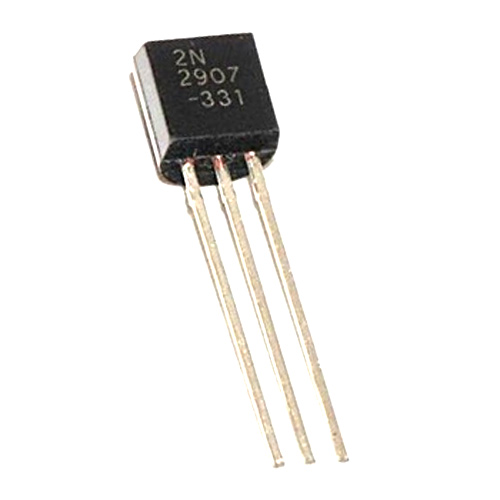
The 2N2907 from QPL is a general-purpose PNP bipolar junction transistor (BJT) suitable for low-power amplification and switching tasks. It is available in TO-92 and TO-18 metal can packages, offering flexibility for various circuit designs.
Key electrical characteristics include a maximum collector-emitter voltage (VCEO) of 40V and a maximum collector current (IC) of 600mA. The DC current gain (hFE) ranges from 100 to 300, indicating its amplification capability. Power dissipation at ambient temperature is rated at 400mW.
This transistor operates within a temperature range of -65°C to +150°C, making it suitable for a wide array of environmental conditions. The 2N2907 can be utilized in common emitter, common base, or common collector configurations for amplifier circuits. Its PNP nature means it is typically ON by default, requiring specific biasing for switching operations.
Applications for the 2N2907 include general-purpose amplification where low power is needed. It can function as a switch, operating in saturation or cut-off regions, and as an amplifier in the active region. Proper circuit design includes adding a series resistor to protect the transistor, with a VBE of 5V for this device.
| Qty | Low | High |
|---|---|---|
| 1+ | $0.99 | $0.99 |
Estimated market price range - modelled values for guidance only, not live distributor offers.
The maximum Collector to Emitter Voltage (VCEO) for the QPL 2N2907 is 40V.
The maximum Collector Current (IC) for the QPL 2N2907 is 600mA.
The maximum power dissipation at ambient temperature for the QPL 2N2907 is 400mW.
The DC Current Gain (hfe) for the QPL 2N2907 ranges from 100 to 300.
The operating temperature range for the QPL 2N2907 is -65°C to +150°C.
The QPL 2N2907 is available in TO-92 and TO-18 package types.
The QPL 2N2907 uses through-hole mounting.