
2210-S231-P1T1-Z241-1A
ETA
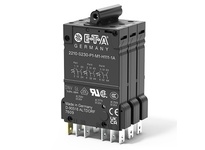
The E-T-A 2210-S231-P1T1-Z241-1A is a 3-pole thermal magnetic circuit breaker rated for 1A and 250VAC/65VDC. It features a lever actuator and panel mount design.


| Category | |
| Manufacturer Name | |
| Actuator Type | |
| Approval Agency | |
| Breaker Type | |
| Current Rating | |
| Current Rating (Amps) | |
| Illumination | |
| Mounting Type | |
| Number of Poles | |
| Operating Temperature | |
| Voltage Rating |
The E-T-A 2210-S231-P1M1-Z241-1A is a thermal magnetic circuit breaker designed for reliable overcurrent protection. This three-pole unit features a 1A current rating and is suitable for a wide range of applications with voltage ratings of 250 VAC (single pole) / 433 VAC (three pole) and 65 VDC.
Built to EN 60934 and IEC 60934 standards, this circuit breaker incorporates a trip-free mechanism and toggle actuation. It is designed for panel or plug-in mounting, offering flexibility in installation. The breaker also includes auxiliary contacts (1 x N/O, 1 x N/C) for status signaling.
Key technical data includes an ambient temperature range of -30°C to +60°C and a typical life of 10,000 operations at 1 x IN inductive load. The device offers an interrupting capacity of 400A or 800A depending on the current rating, and 2,500A at 32VDC under UL 1077 standards. Environmental testing includes resistance to 96 hours of salt mist and 240 hours of humidity.
Typical applications for this circuit breaker include process control equipment, robotics, machine tool control, communications systems, instrumentation, and rail vehicles. Its robust design and compliance with various agency approvals like CSA, GB, and UL make it a dependable choice for industrial and demanding environments.
| Qty | Low | High |
|---|---|---|
| 1+ | $0.99 | $0.99 |
Estimated market price range - modelled values for guidance only, not live distributor offers.
The voltage rating is 250 VAC for single pole and 433 VAC for three pole, with a DC rating of 65 V.
The current rating is 1A.
This circuit breaker has 3 poles.
The ambient operating temperature range is -30°C to +60°C.
Yes, it includes 1 normally open (N/O) and 1 normally closed (N/C) auxiliary contact for status signaling.
It is approved to EN 60934, IEC 60934, CSA C22.2 No 235, GB 17701, and UL1077 standards.