

| Distributor | Stock | Pricing | MOQ | PKG | Lead Time | Date Code | On Order Quantity | On Order Delivery | |
|---|---|---|---|---|---|---|---|---|---|
|
548 pcs
|
548 pcs | On Request | 1 | On Request | On Request | On Request | On Request | On Request |
| Category | |
| Manufacturer Name | |
| Applications | |
| Capacitance | |
| Dielectric Material | |
| Dissipation Factor | |
| ESR (Equivalent Series Resistance) | |
| Failure Rate | |
| Features | |
| Insulation Resistance | |
| Lead Style | |
| Mounting Type | |
| Operating Temperature | |
| Termination | |
| Tolerance | |
| Voltage Rating |
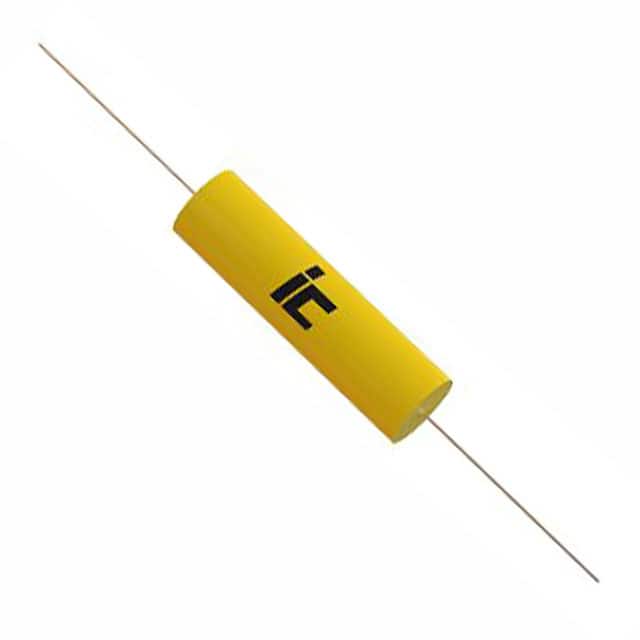
The 106PHC400K is a 10 µF, 400 VDC metallized polypropylene film capacitor from Cornell Dubilier Electronics. It features a ±10% tolerance and is housed in an axial lead package, making it suitable for through-hole mounting.
With an equivalent series resistance of 6.3 mΩ and a self-inductance of less than 1 nH per mm of lead spacing, this capacitor offers excellent high-frequency performance. It operates over a temperature range of -40°C to +85°C (with derating to +100°C). The dissipation factor is 0.06% at 1 kHz, and insulation resistance is 30000 MΩ·µF (not to exceed 3 GΩ).
Designed for DC link, DC filtering, and high-frequency switching circuits, it is commonly used in power supplies, UPS, motor speed controls, and solar heaters. The capacitor is rated for a 250 VAC operation and has a non-repetitive surge voltage of 800 V.
The capacitor is constructed with metallized polypropylene film, flame retardant tape wrap (UL510) and epoxy end fill (UL94V-0). Leads are tinned copper. The dimensions are 27.00 mm diameter by 55.00 mm length.
10 µF with ±10% tolerance.
400 VDC, with a non-repetitive surge voltage of 800 V and AC rating of 250 VAC.
Metallized polypropylene (PP).
Axial lead, through-hole mounting.
-40°C to +85°C (with derating to +100°C).
6.3 mΩ.
DC link, DC filtering, high-frequency switching.